Would you like to save this?
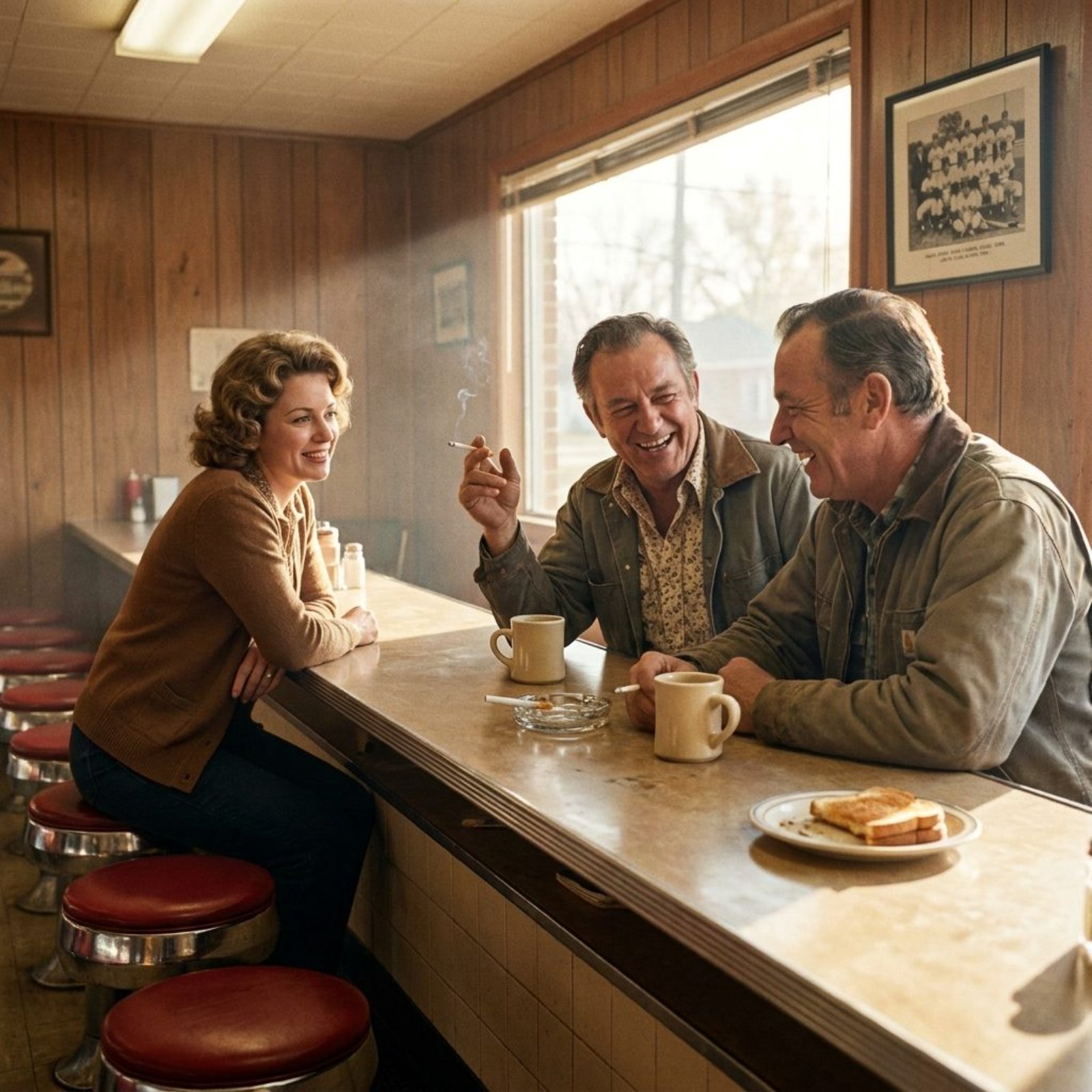
The bell over the door rang and Loretta already knew: two eggs over easy, wheat toast, and bottomless coffee hot enough to fog your glasses. The counter smelled like bacon grease and Winston 100s while the jukebox worked through Glen Campbell for the third time that morning.
You did not go to the 1975 coffee shop to open a laptop or photograph the foam. You went to eat, read the paper, argue about football, and become enough of a regular that somebody started your order the moment your car pulled in.
Fifty years later, the coffee may be better, but almost every ritual around it has changed. These 22 comparisons show exactly how much.
The Coffee Cup Itself
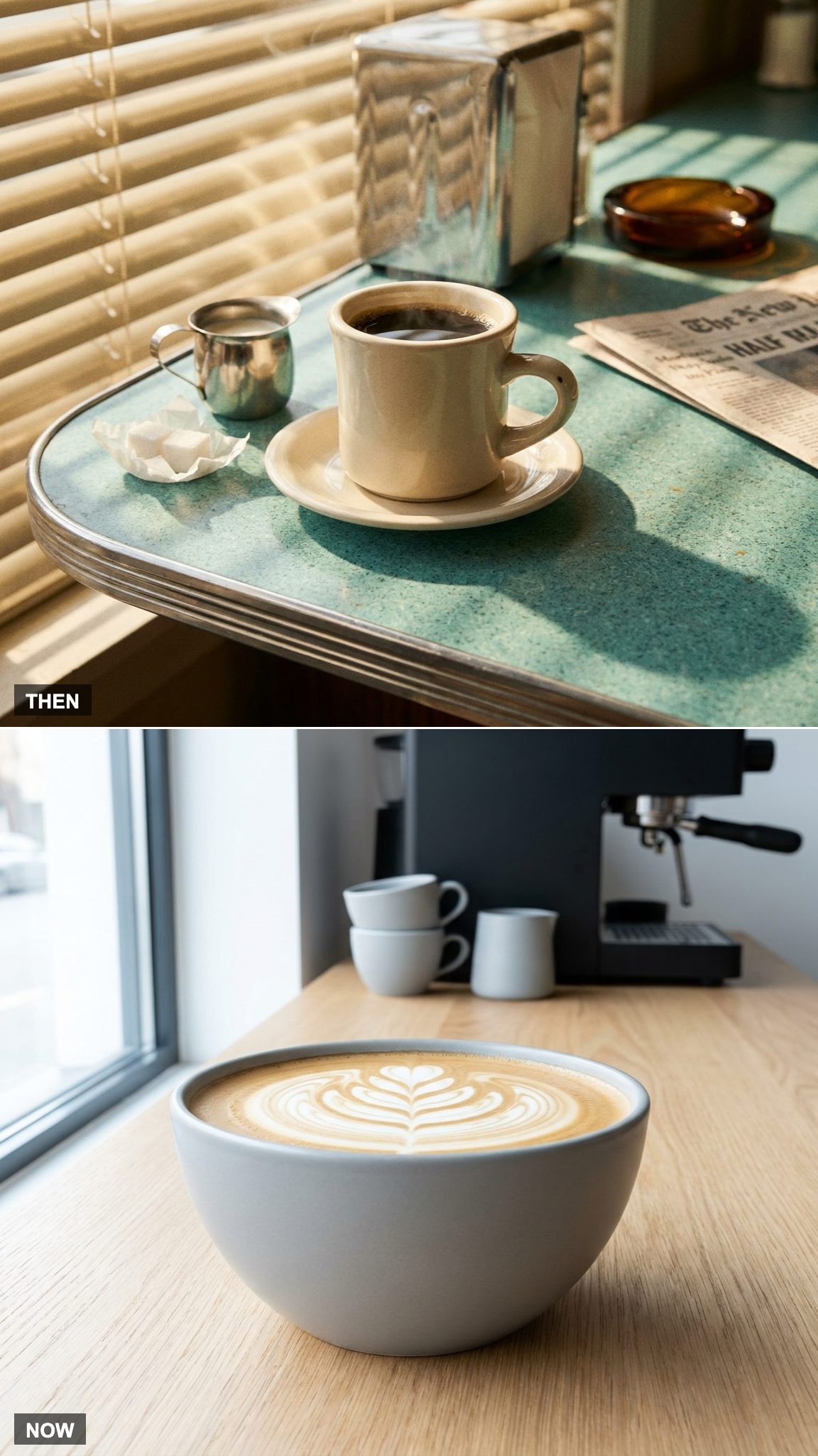
The 1975 mug had heft. You could feel the ceramic against your lip, and the coffee stayed hot because the walls were built like a bunker: eight ounces, maybe ten, and it came back full without you asking.
The modern café cup is often wider, lighter, and designed with latte art and presentation in mind as much as durability. Twelve ounces can look modest beside the 20-ounce option, and the refill is usually another purchase.
The Menu of Drinks
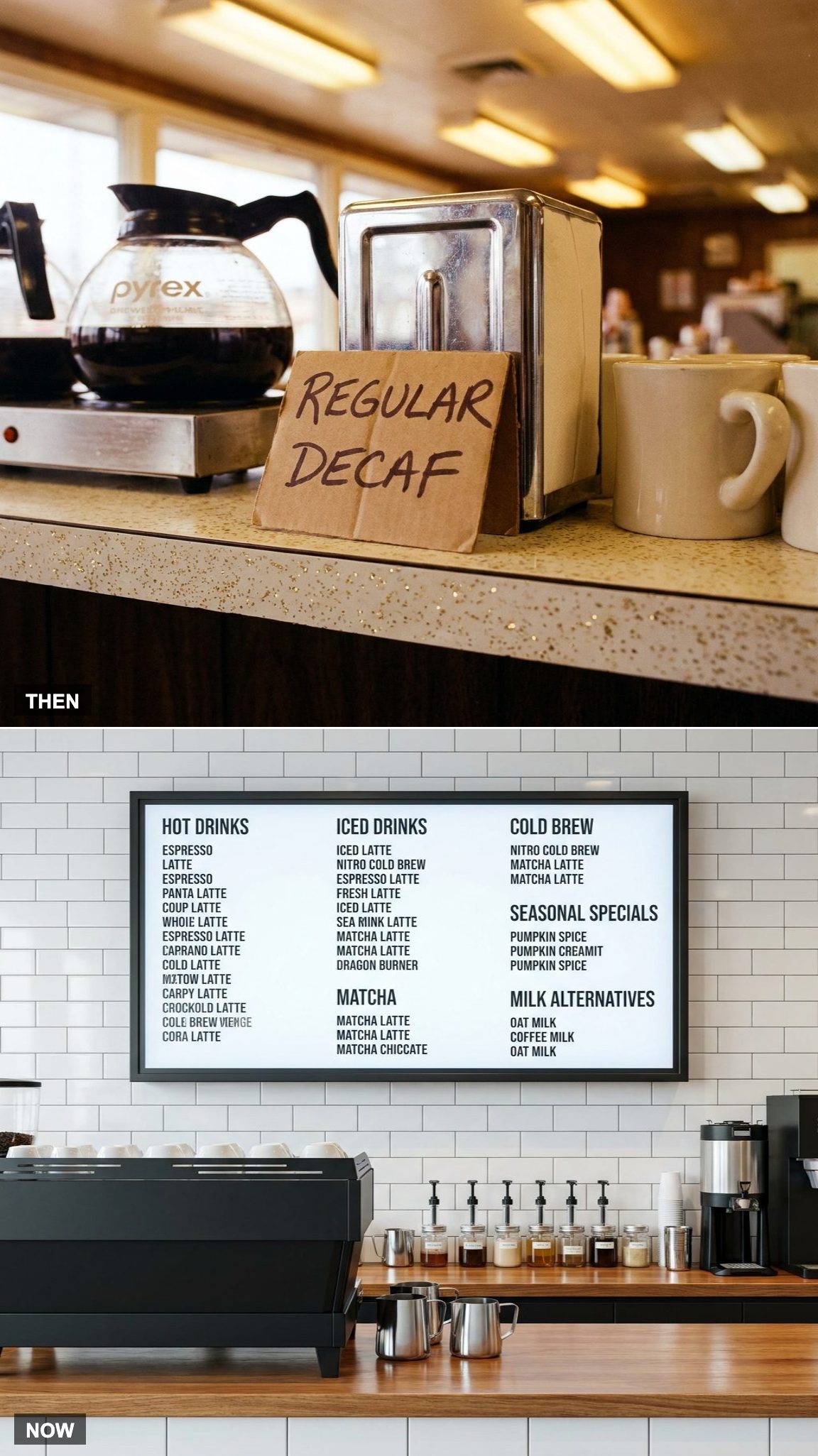
At many coffee shops, the basic choice was regular or decaf. Ask for anything more elaborate and you had probably walked into the wrong room.
The current menu runs to dozens of possible combinations before you even factor in the milk alternative, the syrup pump, the temperature preference, and the size ladder. A modern barista training manual is thicker than most 1975 diner menus were, cover to cover.
The Refill Ritual
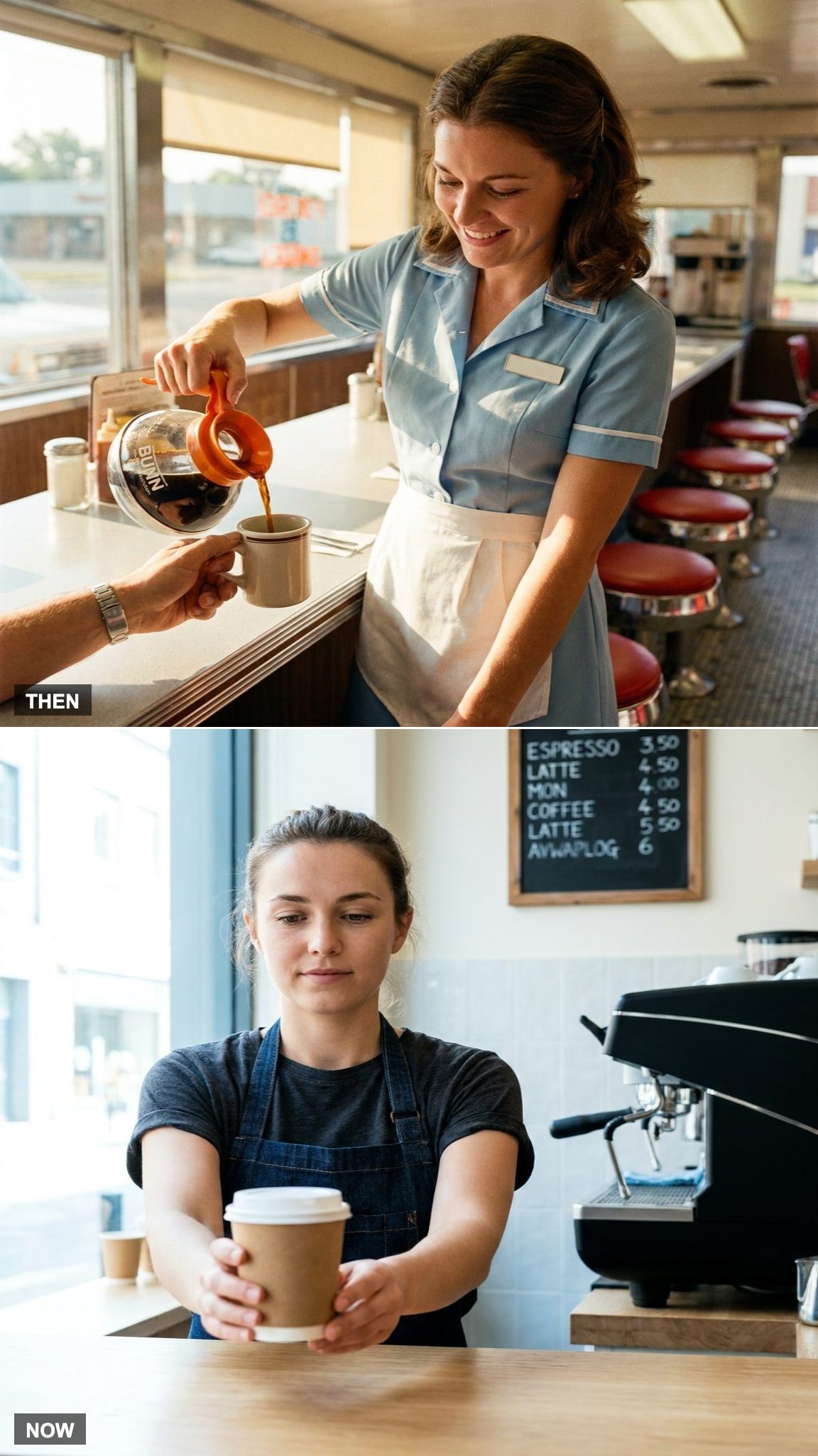
The pot never stopped moving. She’d top you off mid-sentence, mid-bite, mid-argument with your brother-in-law about the Steelers. You didn’t ask for it. It just kept happening until you flipped your mug upside down on the saucer to signal enough.
At many specialty cafés, one drink equals one transaction. Want more? Back in line. Traditional diners still pour refills, but the bottomless cup is no longer the default wherever coffee is sold.
The Smoking Section (Which Was Everywhere)
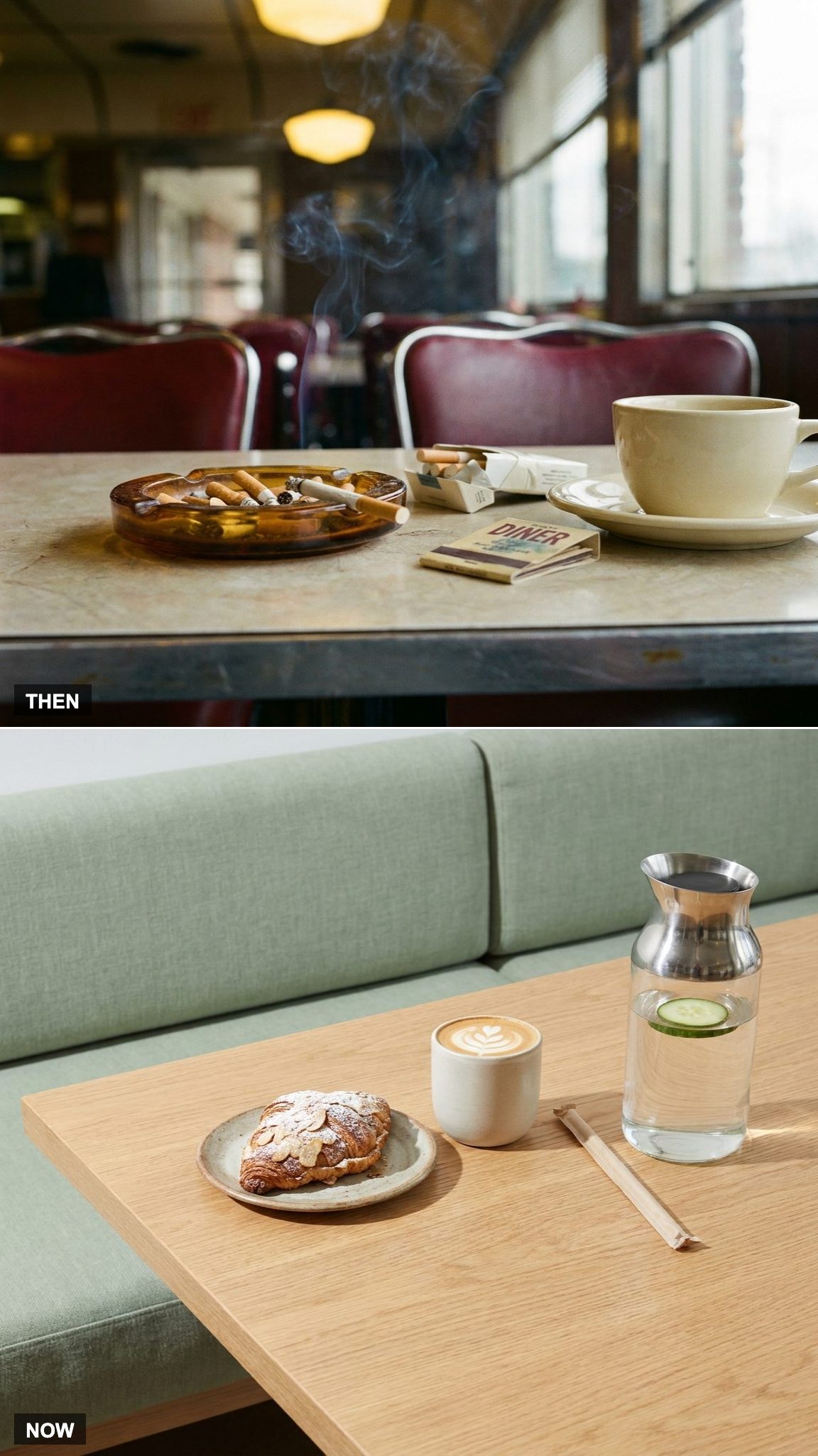
Every table had an ashtray, and not a decorative one. A working one, changed by the busboy along with your water glass. The air had a permanent blue tint at head height, and your sweater smelled like the room for three days after.
Now smoking a cigarette inside a café would get you removed by staff before your foot cleared the threshold. In many cities, smoking is restricted on café patios too. The ashtray, once as standard as the salt shaker, is a museum piece.
The Seating
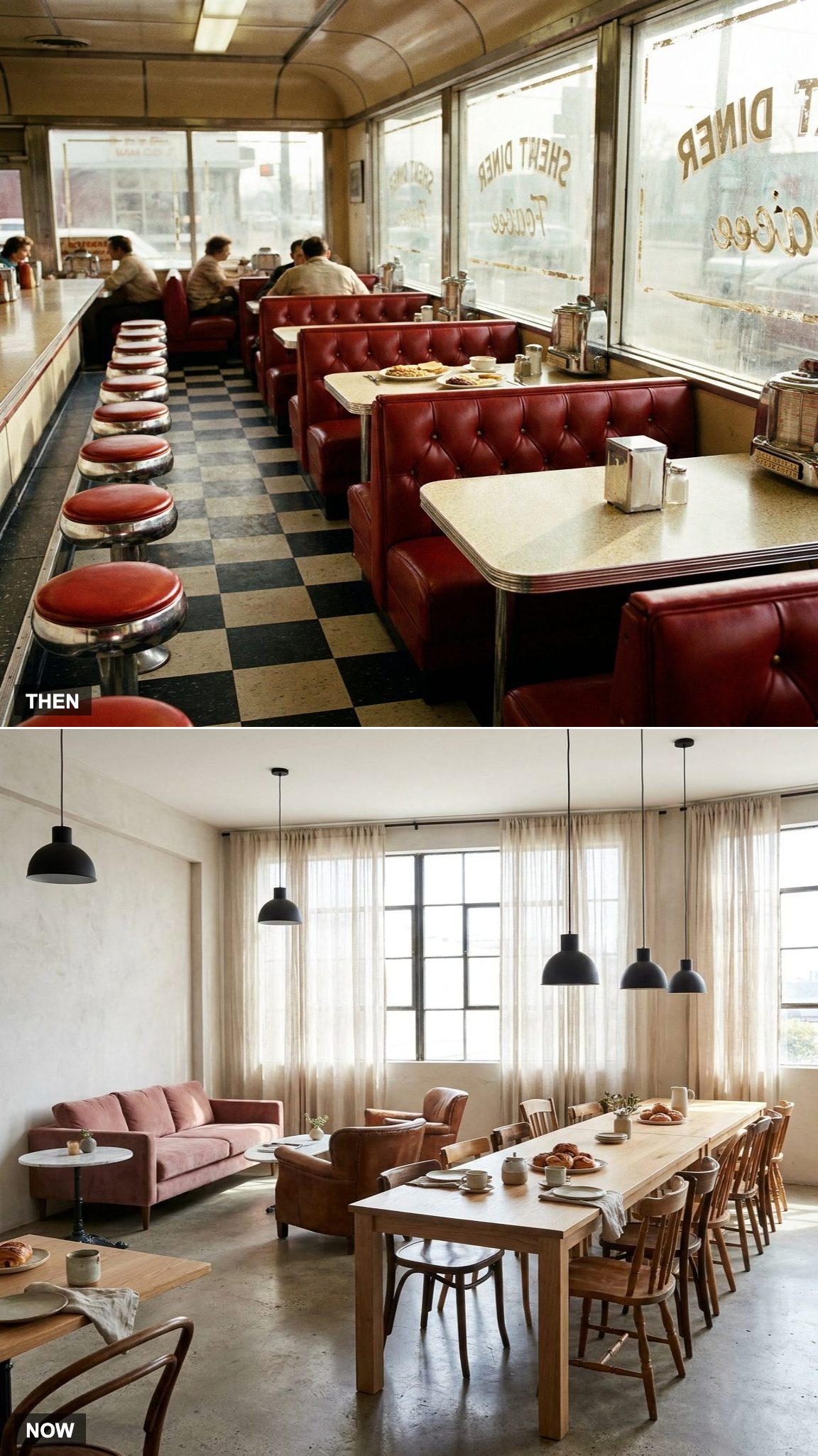
The booth was the point. Red vinyl patched with silver duct tape near the back where somebody’s belt buckle had opened it up in 1971, chrome rim on the table gone dull from wear. You slid in and you were in a small private country for the length of a meal.
The modern café has decided you should sit on a sofa next to a stranger, or share an eight-foot oak plank with four laptop users and their tote bags. They call it community. What it means in practice is that nobody makes eye contact.
The Menu Board
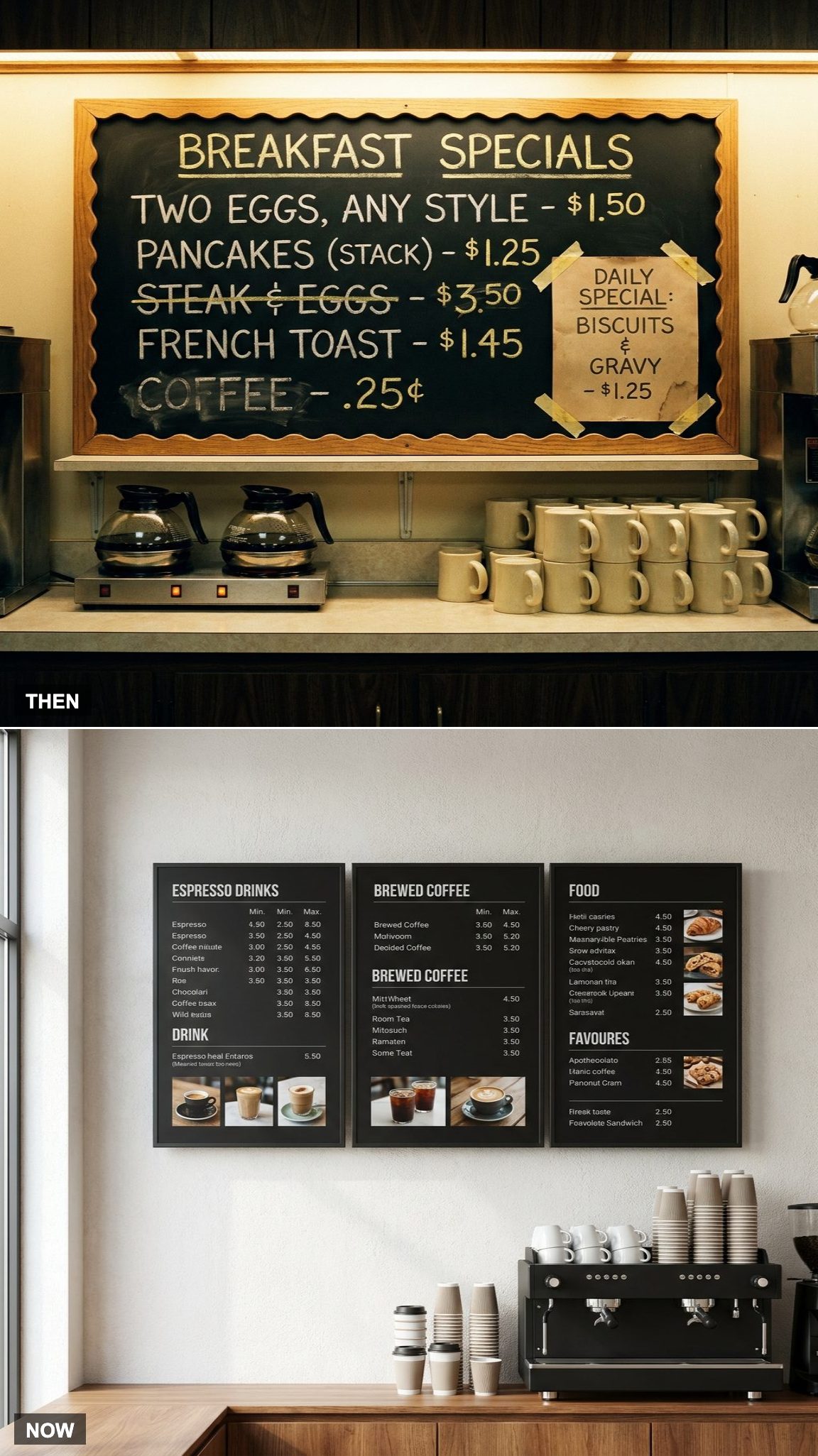
Somebody wrote the menu every morning, often in loopy cursive, with the specials in yellow chalk. When the price of eggs went up they wiped off the old number with a wet rag and wrote in the new one. The whole board was a working document.
The digital board can update remotely from a corporate system. Nobody sees the wet rag, the erased number, or the moment the price changes.
What Everyone Was Reading
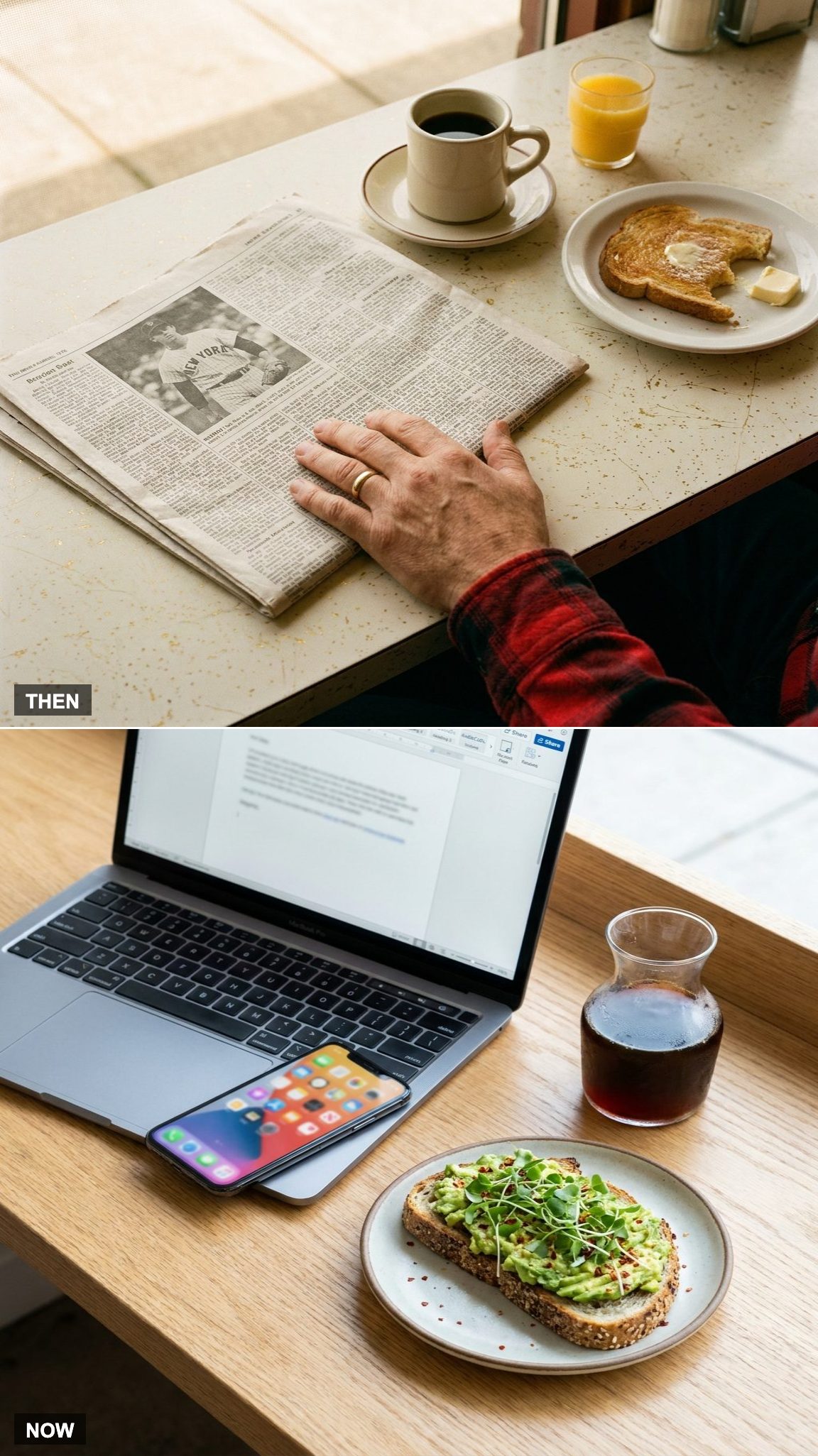
Sports section for the men at the counter, local section for the retirees in the back booth, and somebody always had the crossword and a pencil borrowed from the hostess stand.
Now every head tilts down at the same angle, a glowing rectangle throwing blue light onto the underside of the chin. Walk through a café at 9 a.m. and you’ll hear nothing but keyboard clicks and the milk steamer.
How You Paid
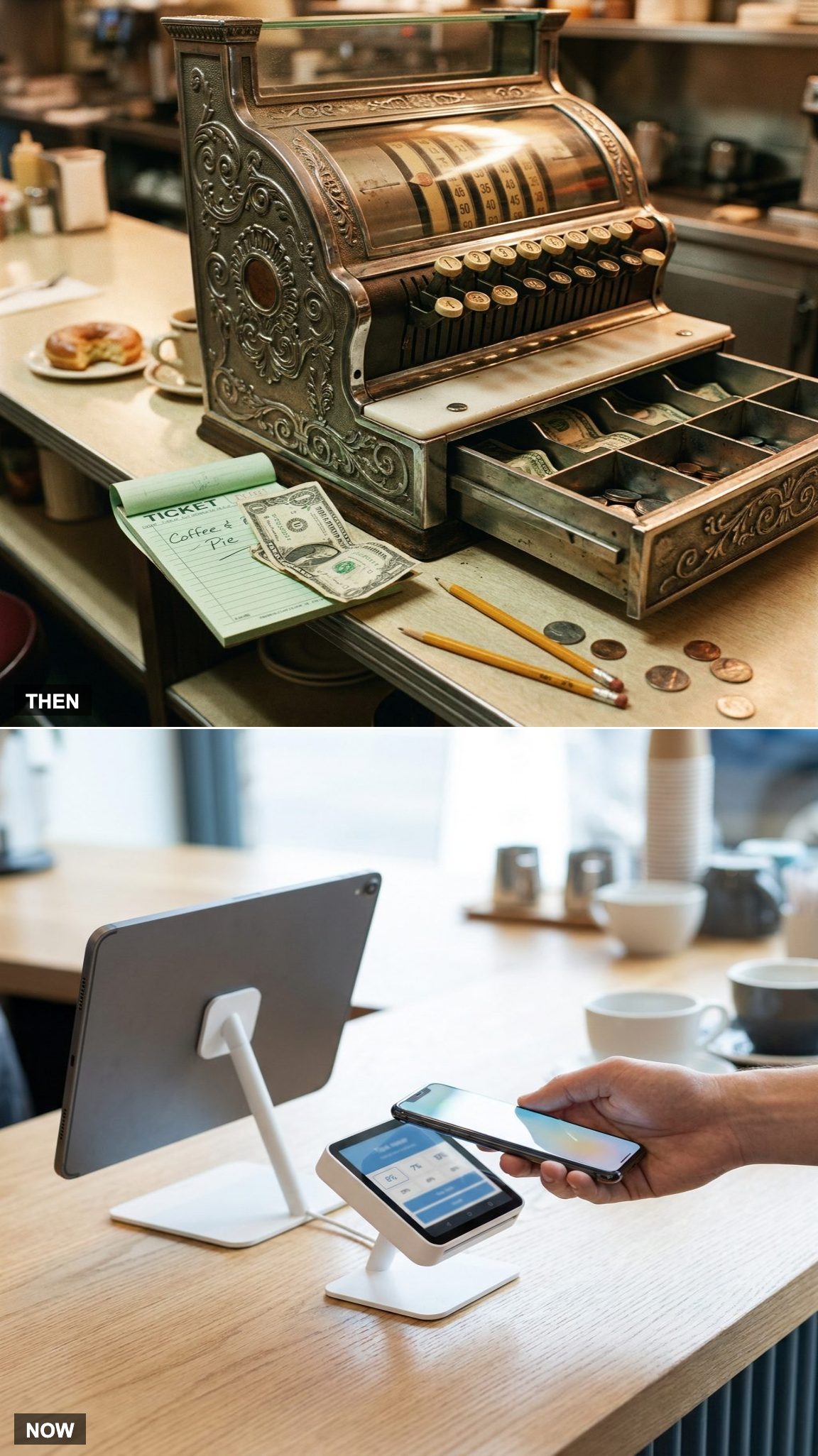
The register was a piece of furniture: cast iron and chrome, a drawer that opened with a bell, keys that clacked when the waitress rang you up. She counted your change back into your palm. Coins first, then bills, always facing the same way.
Today you tap a phone against a plastic square and a screen asks you to choose between three tip percentages on a four-dollar coffee. Done in under a second. Nobody says anything.
The Thing on the Pastry Counter
Would you like to save this?
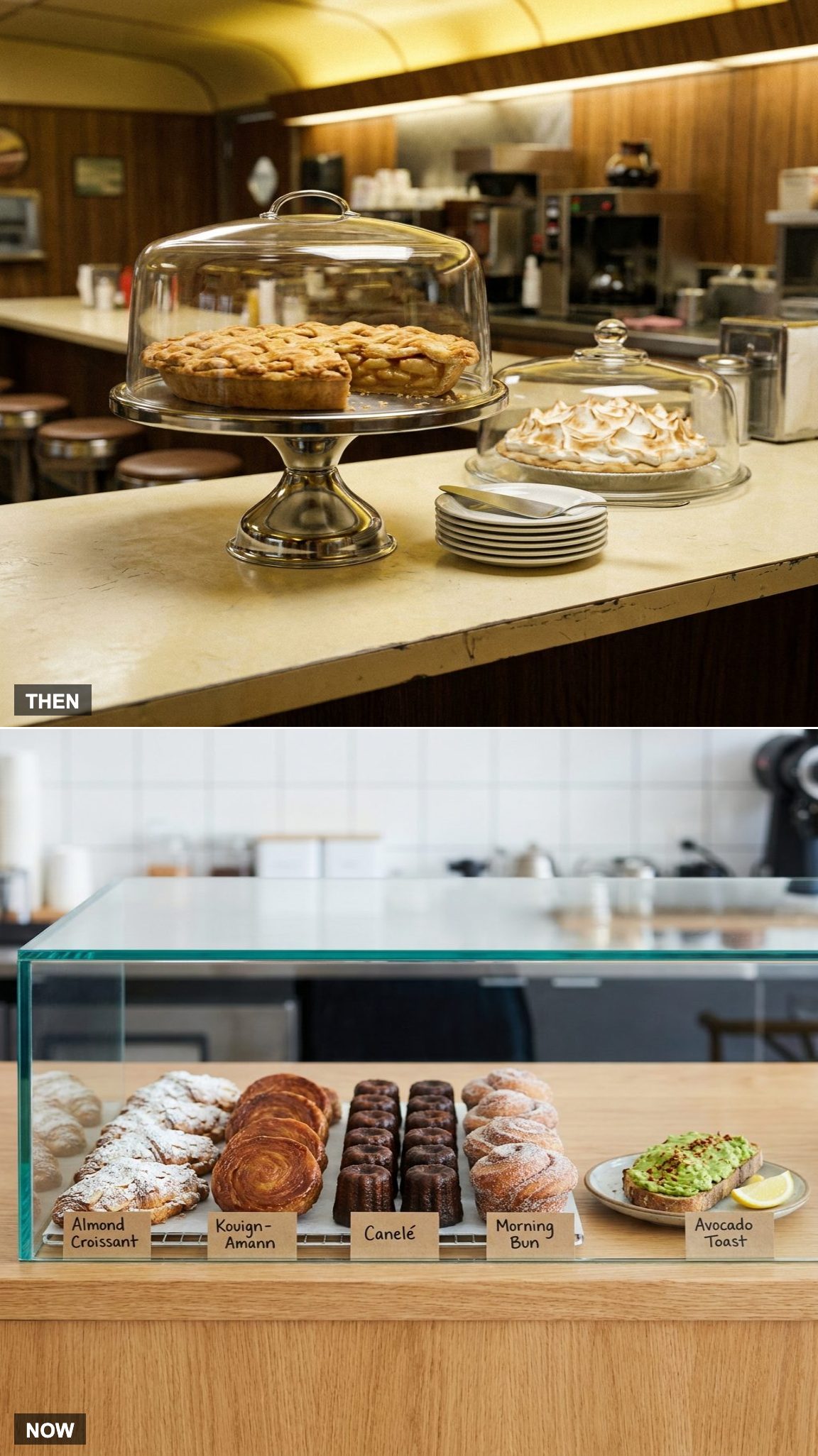
Pie under glass. That was the dessert program: apple, cherry, coconut cream, banana cream, whatever had come out of the kitchen that morning. Add a scoop of ice cream for a little more.
The current pastry case is a passport: a canelé from Bordeaux, a kouign-amann from Brittany, an almond croissant that took days to laminate. Pie, if it appears at all, has become the special rather than the default.
How the Regulars Ordered
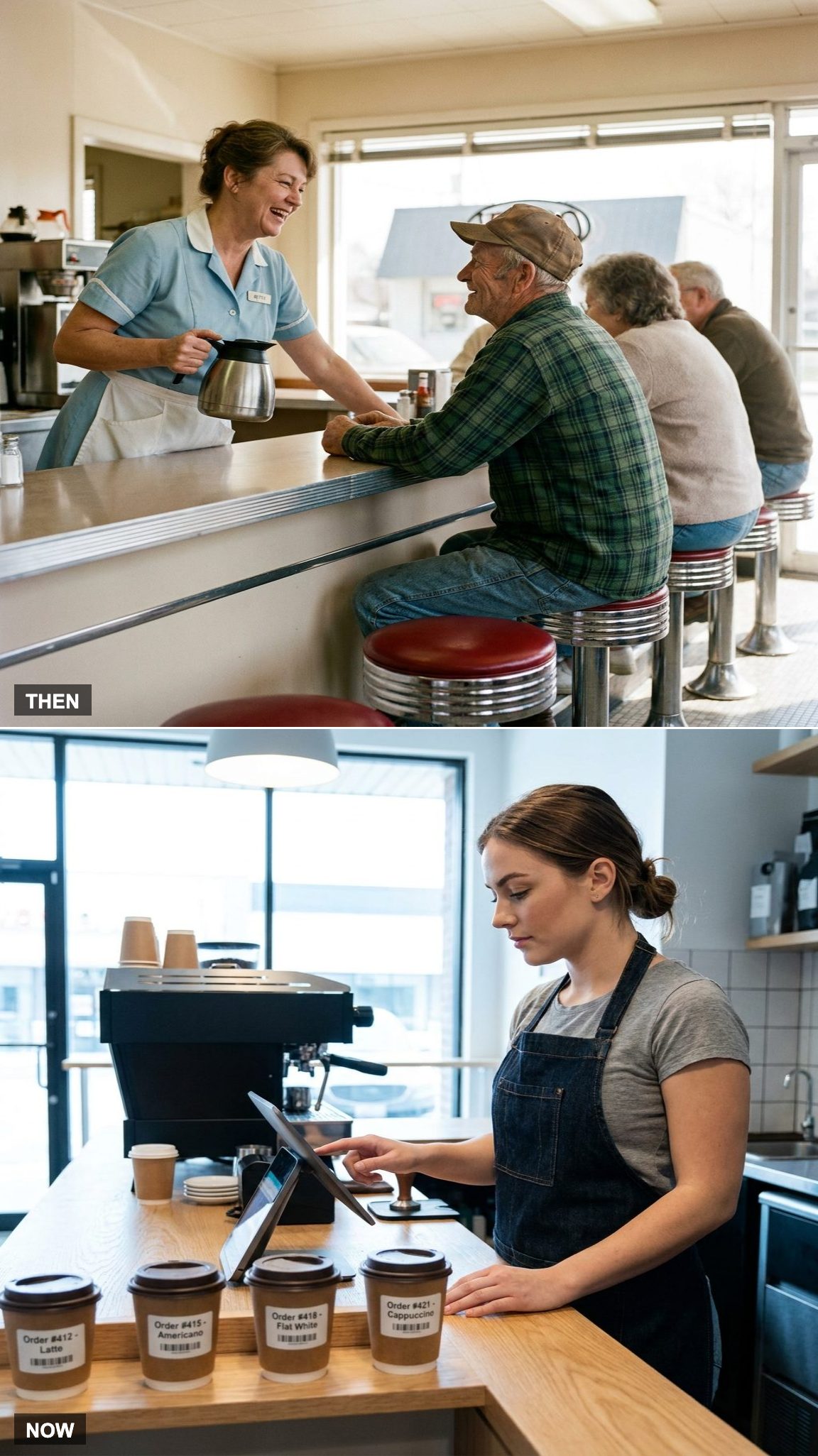
Loretta knew you took two sugars. She knew your wife’s name, your kid’s college, and whether the Buick was still giving you trouble. You didn’t order. She started the order when she saw your truck pull in.
The app knows your name too. It may also store your card, birthday, favorite order, and nearest location. It can retrieve the transaction instantly, but it cannot ask whether the Buick ever made it out of the shop.
The Percolator’s Slow Bubble vs. The Espresso Machine’s Hiss
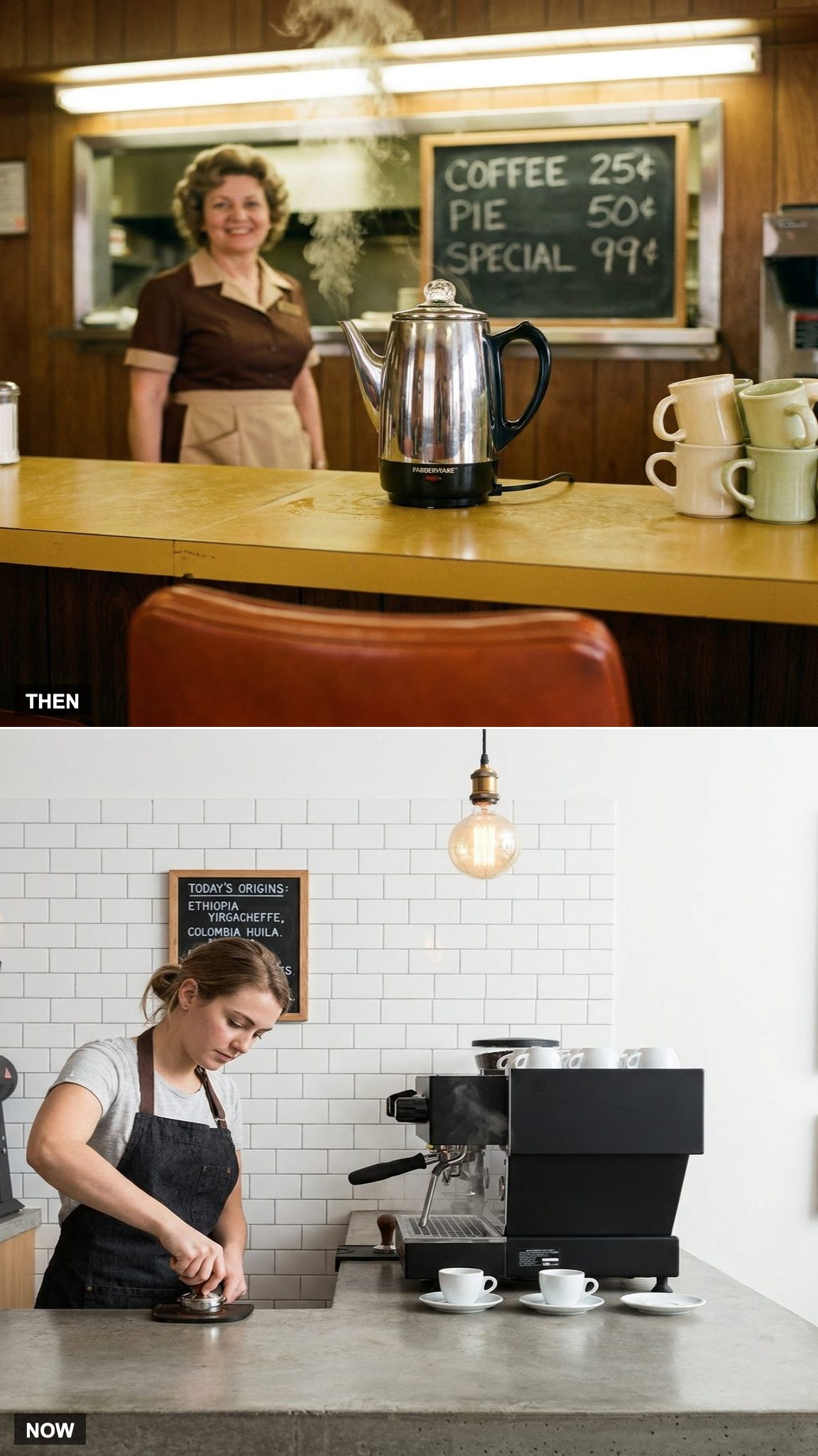
The 1975 coffee shop announced itself through smell before you touched the door. A percolator or commercial brewer had filled the pot, and the burner kept it hot long enough for the last cup to taste much stronger than the first.
The modern café swapped smell for sound. Steam wand hiss, the grinder’s high whine, the metallic knock of a portafilter emptying into a knockbox. Espresso is theater now: chrome, matte black, operated by someone who trained for months to pour a leaf into your foam.
House Drip vs. The Single-Origin Menu
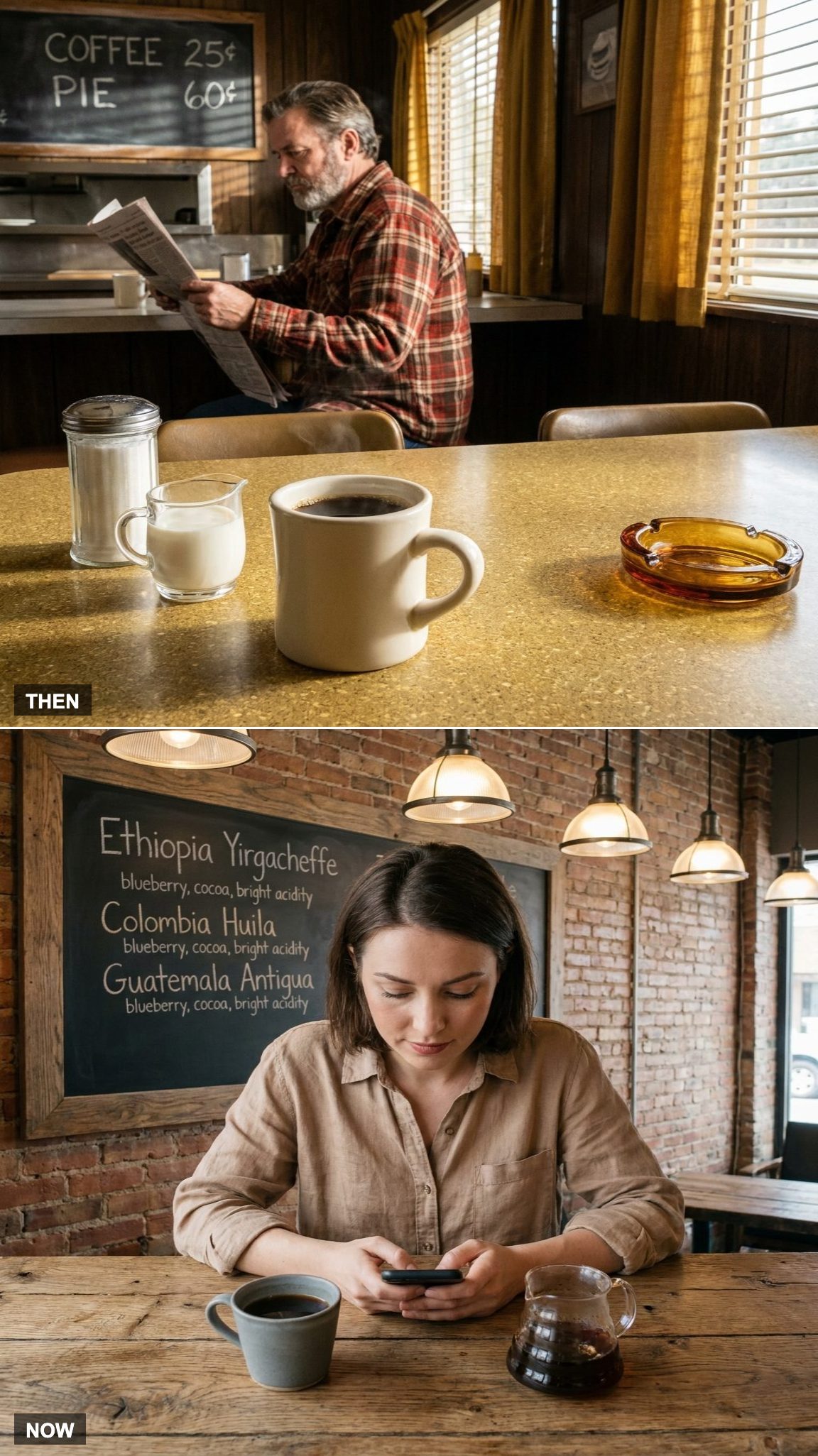
Ordering coffee in 1975 took a second. You said coffee, they poured coffee, and nobody asked where the beans came from because nobody thought about it. The bag said Folgers or Maxwell House and that was the whole story.
Today’s menu reads like a wine list: elevation, farm name, processing method, tasting notes that promise blueberry and cocoa in something that used to just taste like coffee. Some of it is real. Some of it is theater. Both can be true at once.
The Cream Pitcher vs. The Milk Alternative Lineup
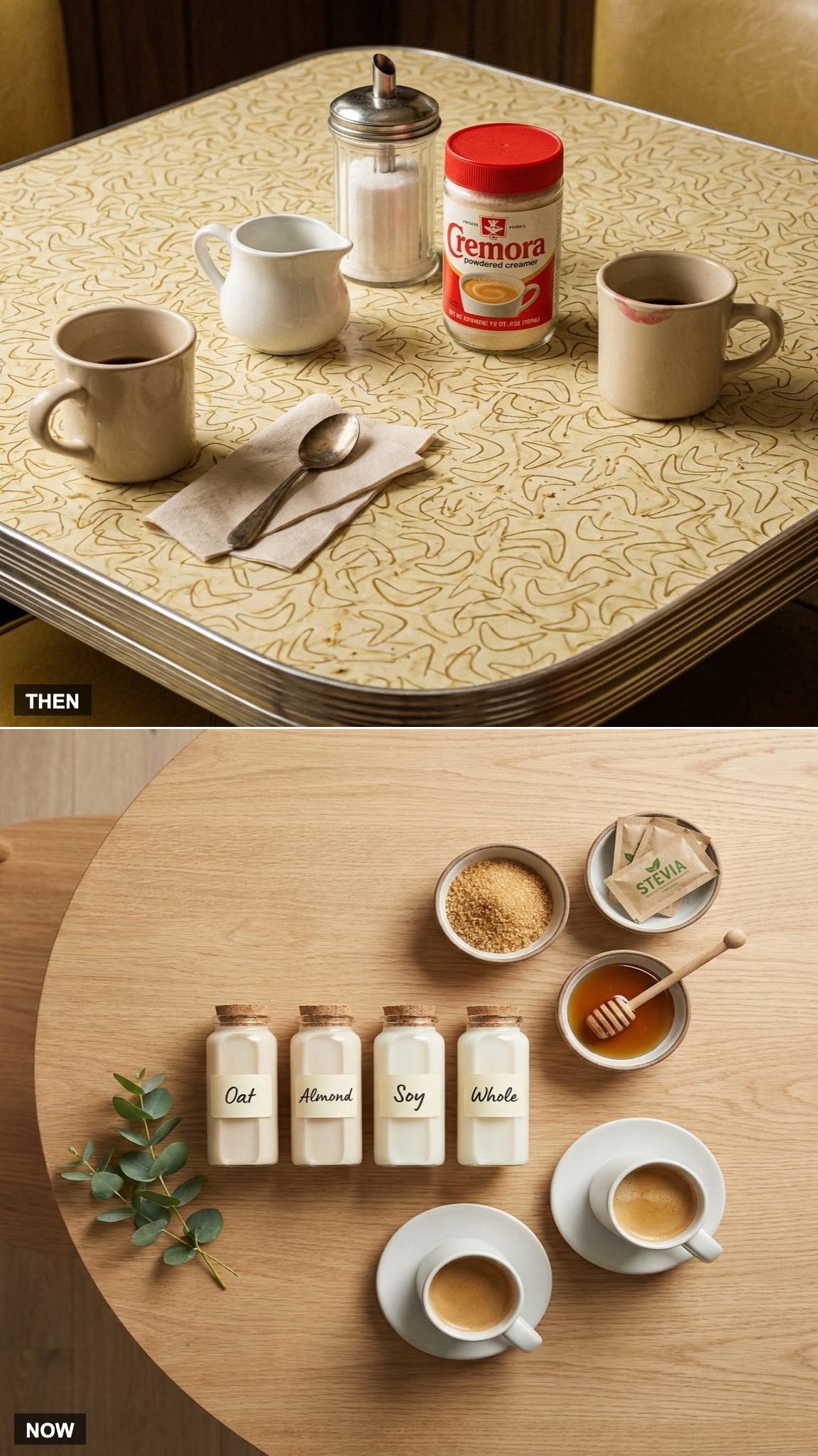
Cream or sugar. That was the whole conversation.
The pitcher was ceramic, the sugar came in a glass shaker with a metal flip-top that clogged in humid weather, and a jar of Cremora sat there for anyone who wanted their coffee to taste faintly of chalk. Nobody read labels. There was one label to read.
Now the barista runs through options like a flight attendant covering safety procedures: oat, almond, soy, coconut, macadamia, whole, two percent, skim. Some cafés charge extra for nondairy milk; others do not.
The 5 a.m. Rush vs. The All-Day Laptop Camp
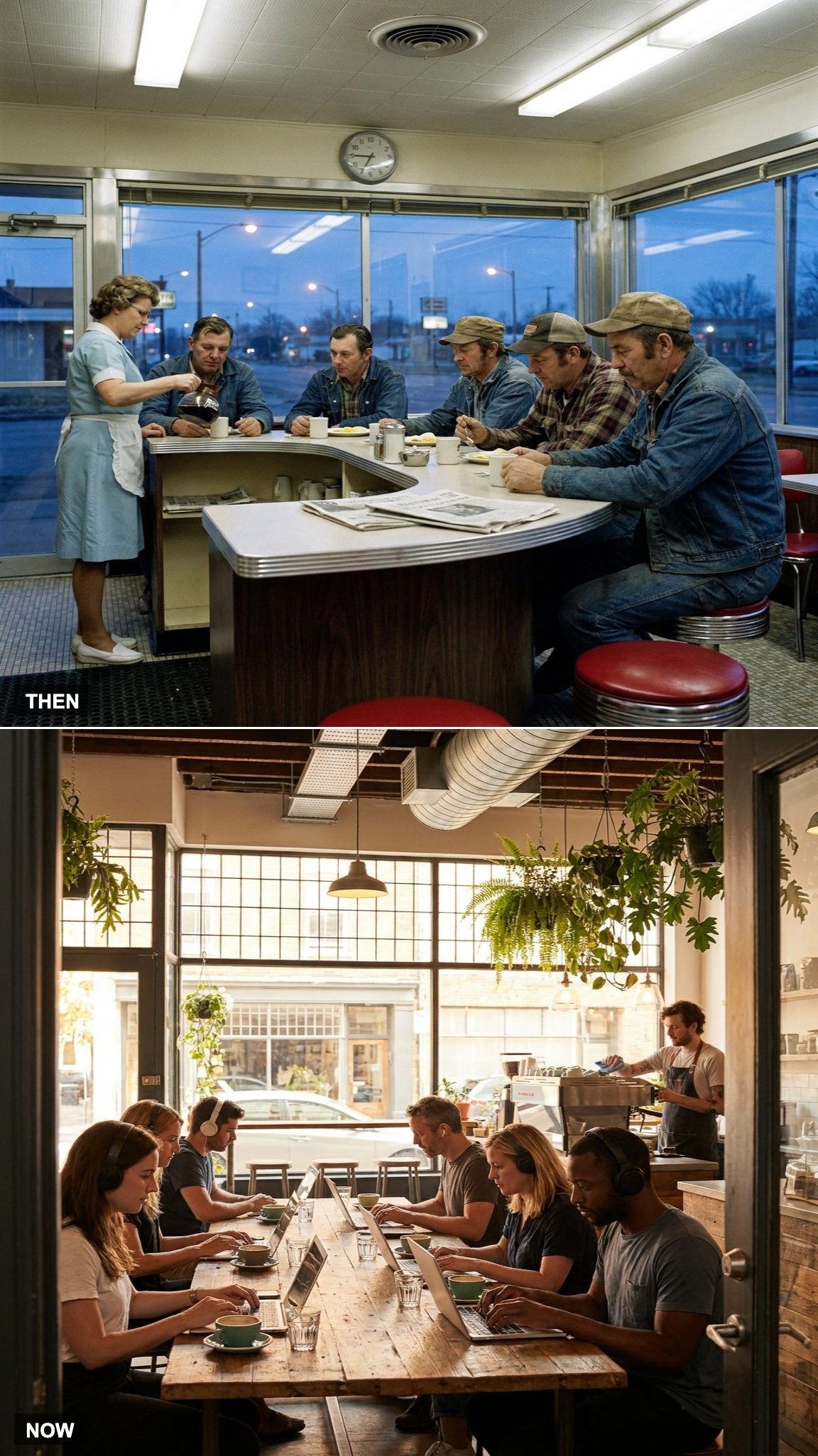
The 1975 coffee shop opened for people who had somewhere to be: framers, mechanics, night-shift nurses coming off, men in ties heading downtown. Most customers sat, drank, paid, and left. The seat rarely stayed empty for long.
Today’s café is a rented office. One drink buys four hours, sometimes six. The stools are gone. The tables have outlets. The person next to you is on their third video call and their second matcha, and they will still be there when you leave.
Counter Conversation vs. Headphones and Silence
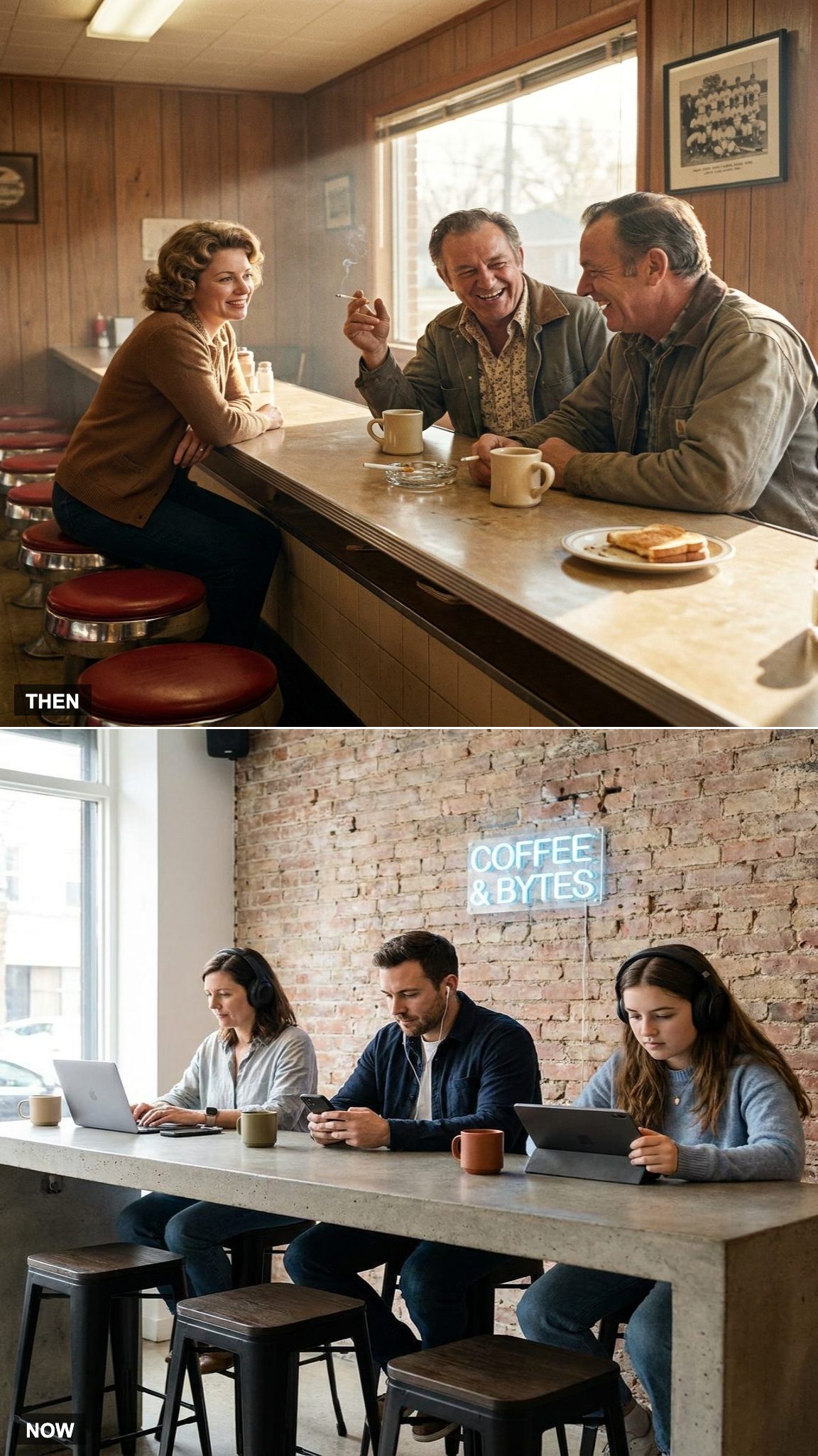
Strangers talked at the counter in 1975. Not always well, sometimes about nothing, sometimes the same three men arguing about the same football game they had argued about the week before. The counter was designed for it: elbow to elbow, no personal bubble to defend, no headphones to signal leave-me-alone.
Modern cafés built silence into the floor plan. Headphones on, screen up, do not disturb. You can sit next to someone for two hours and never learn their name. Worse? Not necessarily. Just different.
The counter was a social technology. Nobody called it that at the time, but that is what it was.
The Mom-and-Pop Coffee Shop vs. the Modern Specialty Café
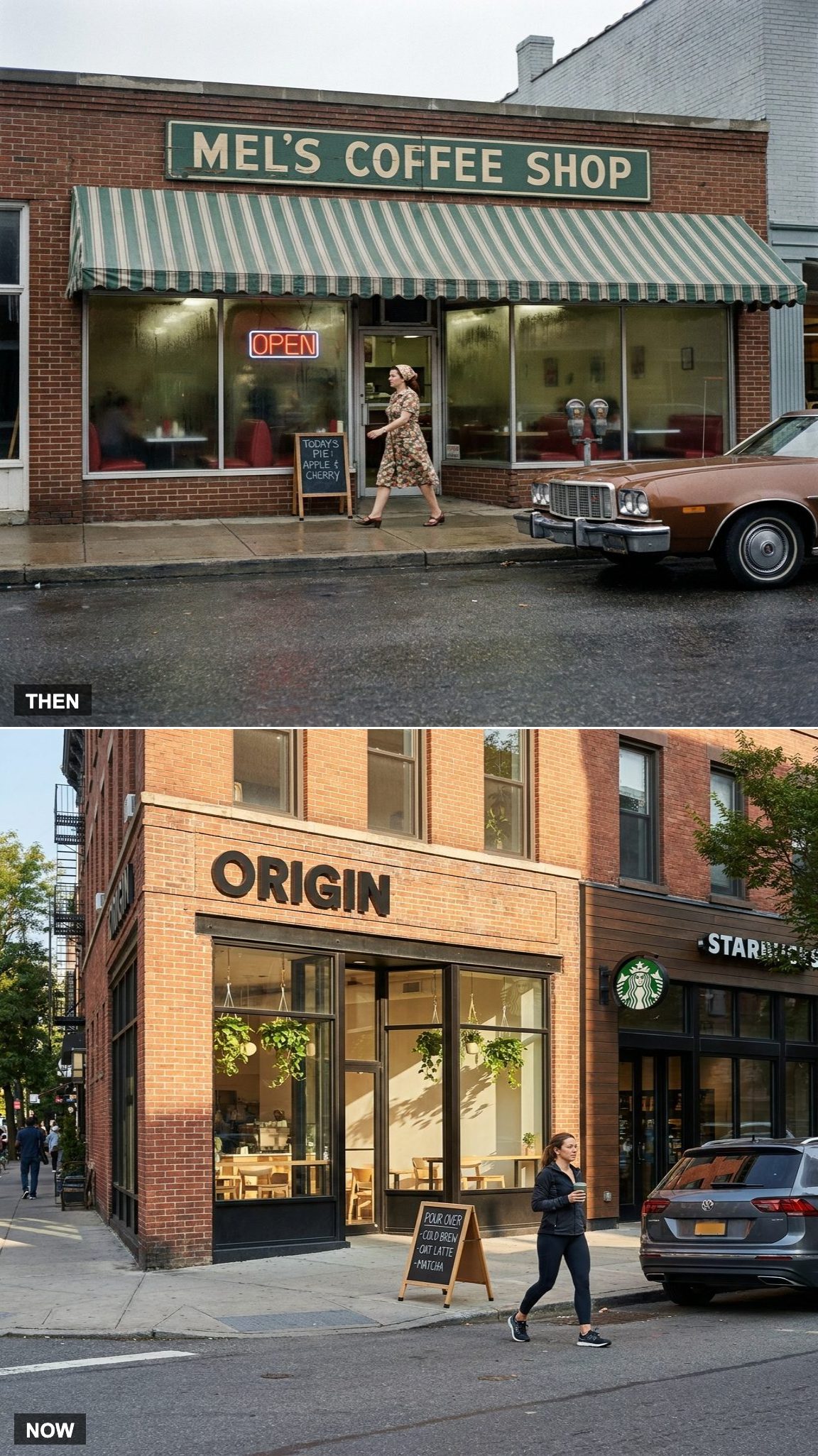
Every main street in 1975 had a Mel’s, a Rosie’s, a Joe’s, named after whoever owned it, run by that same person, staffed by their sister or their kid. The coffee was fine, the pie was better, and the rent was manageable because the landlord ate there too.
Now the same block may hold a national chain, a drive-through, and one independent café charging enough for a cortado to cover costs the old diner never faced. The family-run shop is not extinct. It is simply harder to sustain.
Wurlitzer in the Corner vs. Spotify Overhead
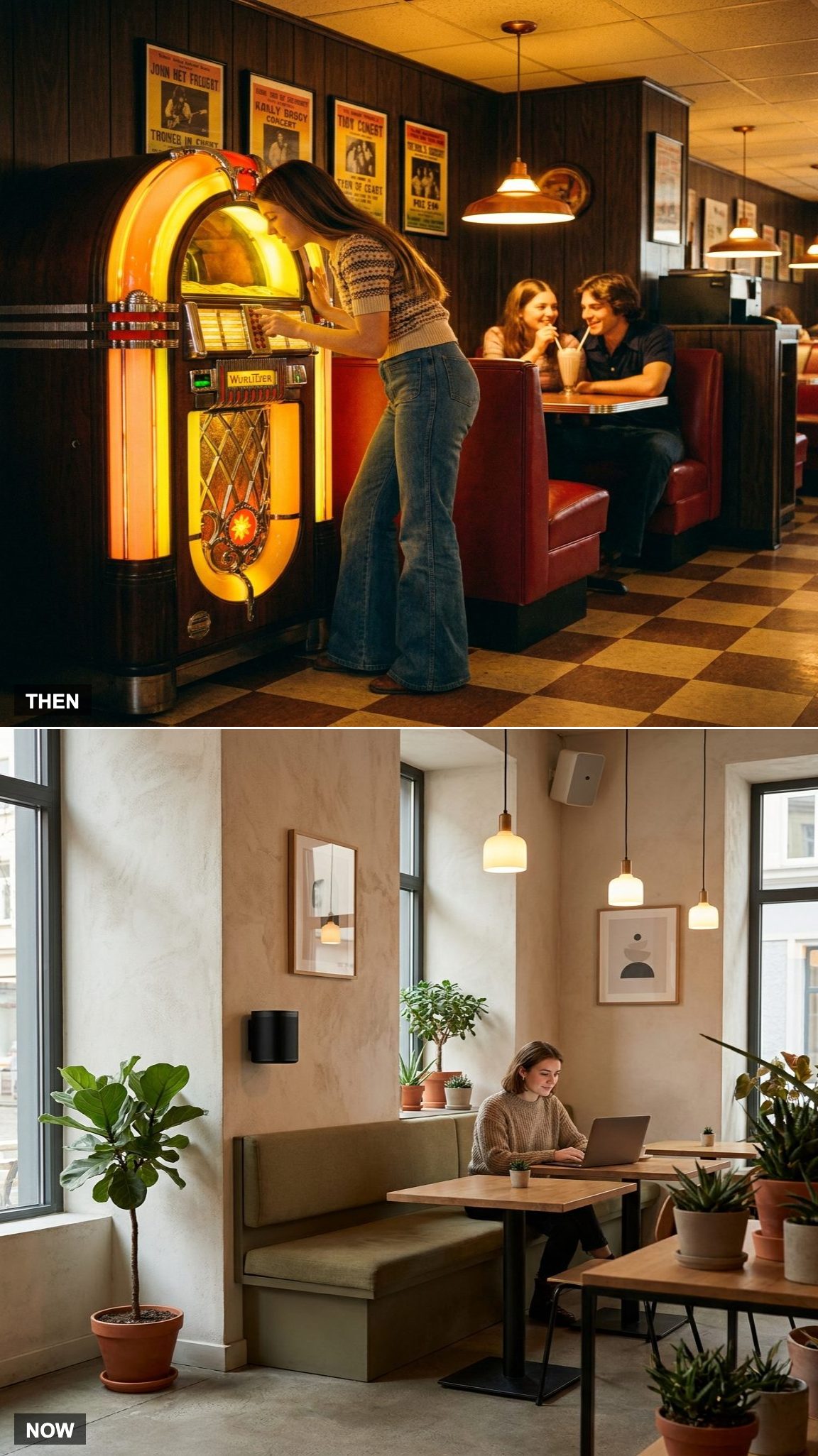
The jukebox was participatory music. A quarter, three songs, and everyone in the room heard what you picked, sometimes Fleetwood Mac, sometimes the same Neil Diamond track four times running because a kid thought that was hilarious. The room voted with quarters, and the loudest quarter won.
The overhead playlist is now more likely to come from a corporate music service or a carefully assembled streaming account, chosen to create a consistent atmosphere. Nobody feeds it a quarter or argues with the selection.
A Quarter for a Cup vs. Seven Dollars for a Latte
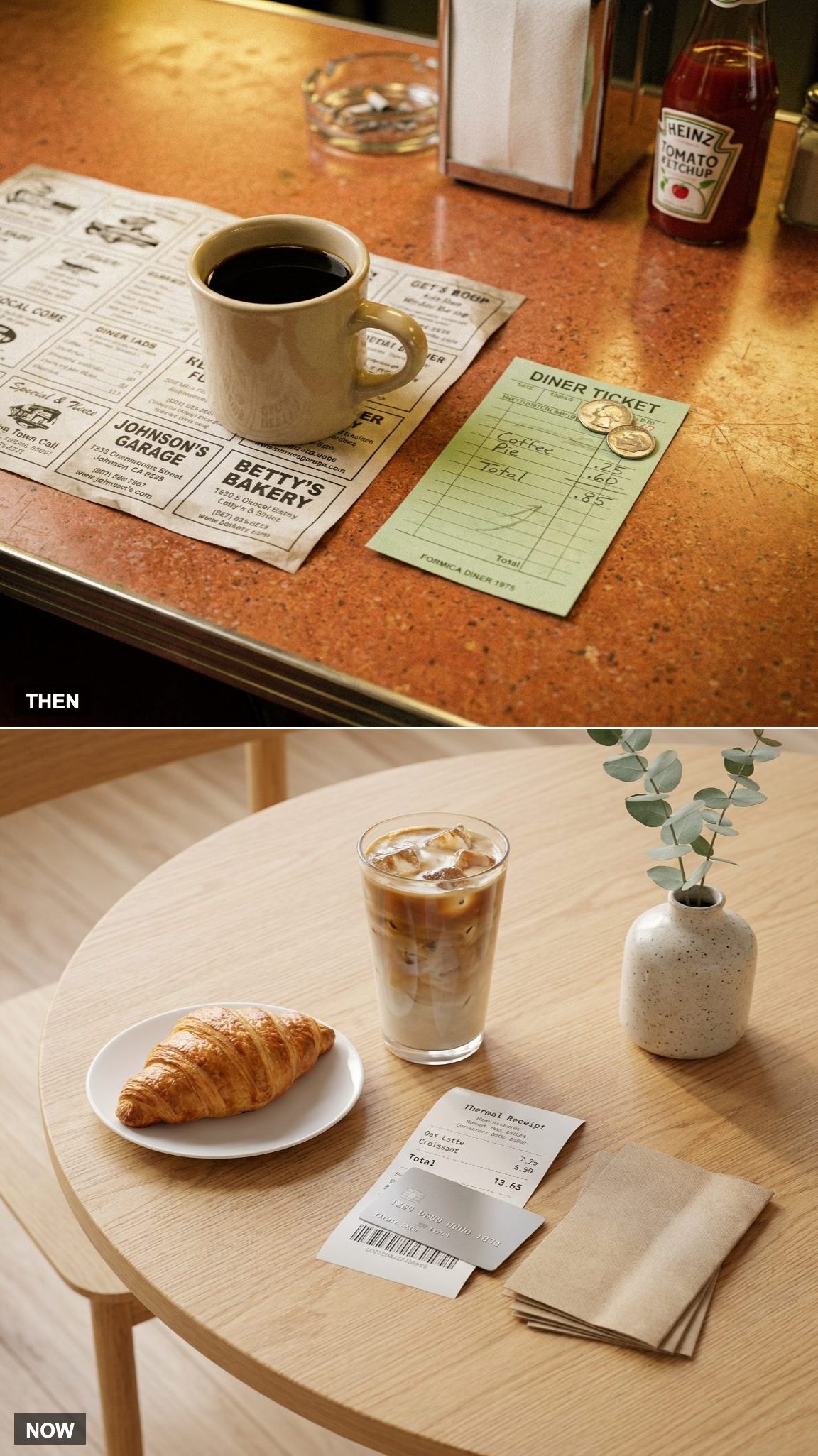
A quarter bought coffee in 1975. Not fancy coffee, just coffee, endless refills usually included, in a mug that had seen fifteen years of service and would see fifteen more.
The specialty drink today is a small luxury purchase, priced accordingly. Seven dollars for a latte was unthinkable in 1975, and it would still sound absurd if we had not spent twenty years slowly getting used to it. The pricing did not shift overnight. It crept.
Table Service vs. the Self-Serve Fixings Bar
Would you like to save this?
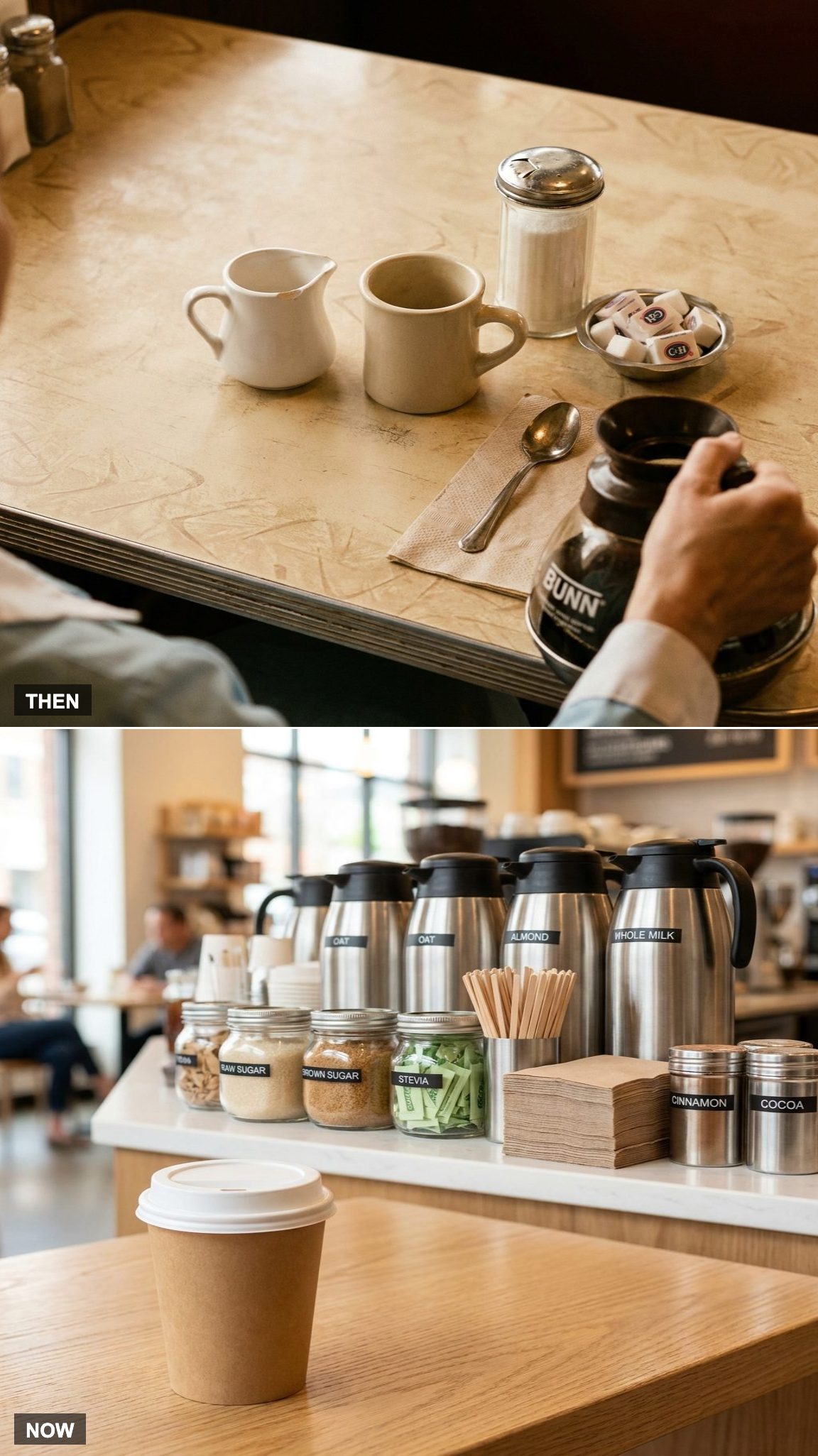
The ceramic creamer represented a small act of table service. Someone filled it in the back, carried it over, and trusted you to use what you needed. Refills arrived without another order or a name written on the cup.
The fixings bar moved that work onto the customer. It sped up service, reduced labor at the table, and let each person adjust the drink without waiting. It was a real design decision, and it changed the rhythm of the visit.
The Neighborhood Living Room vs. The Grab-and-Go Line
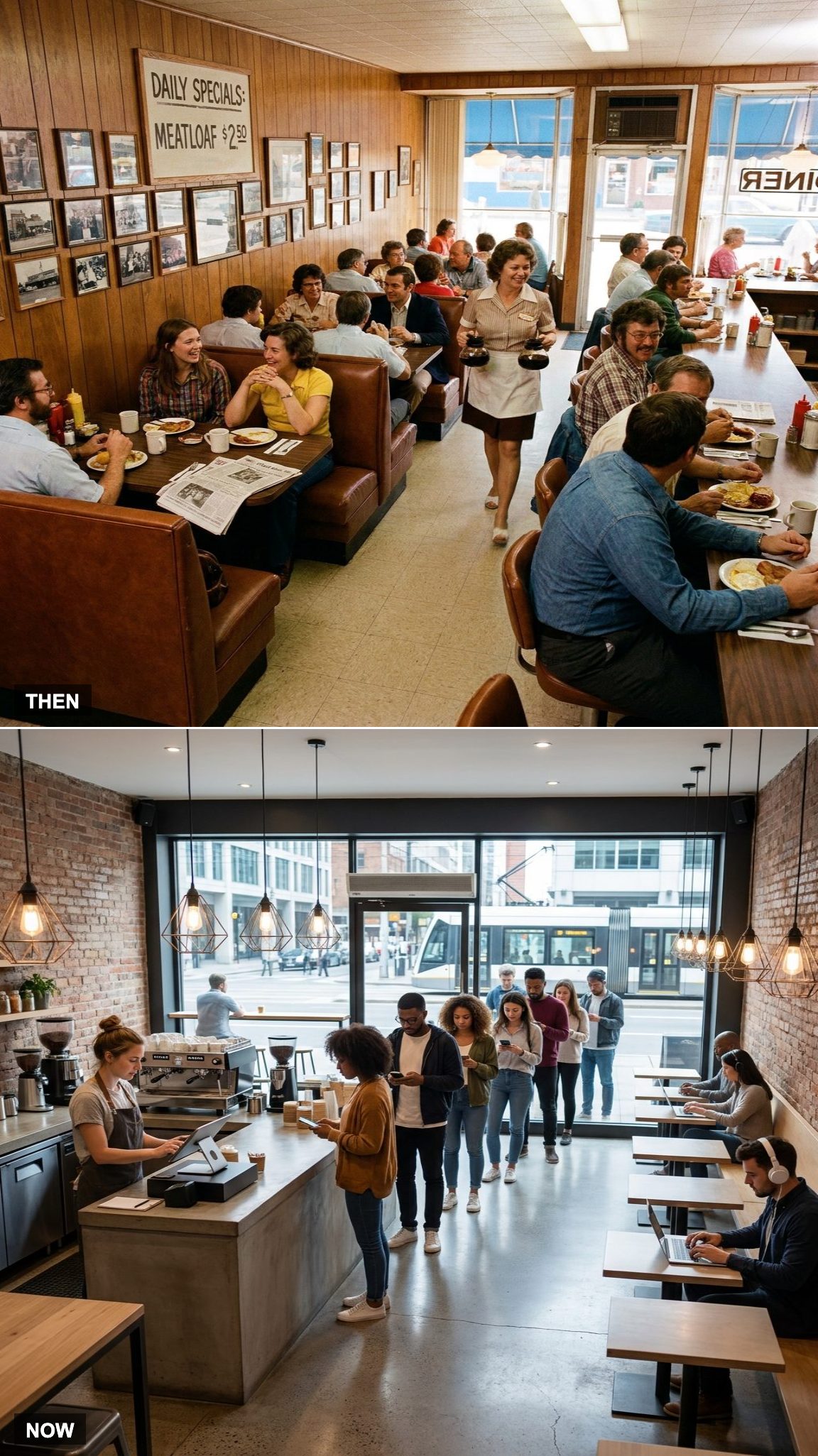
The 1975 coffee shop was infrastructure. It was where you heard your neighbor’s husband was in the hospital, where the little league coach recruited, where the same four retirees met every morning at the same booth for thirty years running. Nobody scheduled any of it. It happened because the space made it easy.
The grab-and-go line does something different: efficient, often excellent, honest about what it is. The drink is the product. The room is not.
Neither model is wrong. But something has quietly gone missing: the accidental community, the kind that only forms when people sit still in the same room long enough to notice each other. Some cafés are trying to bring it back. Most were never built for it.
Before: The Décor Just Had to Work. After: The Room Is the Brand.
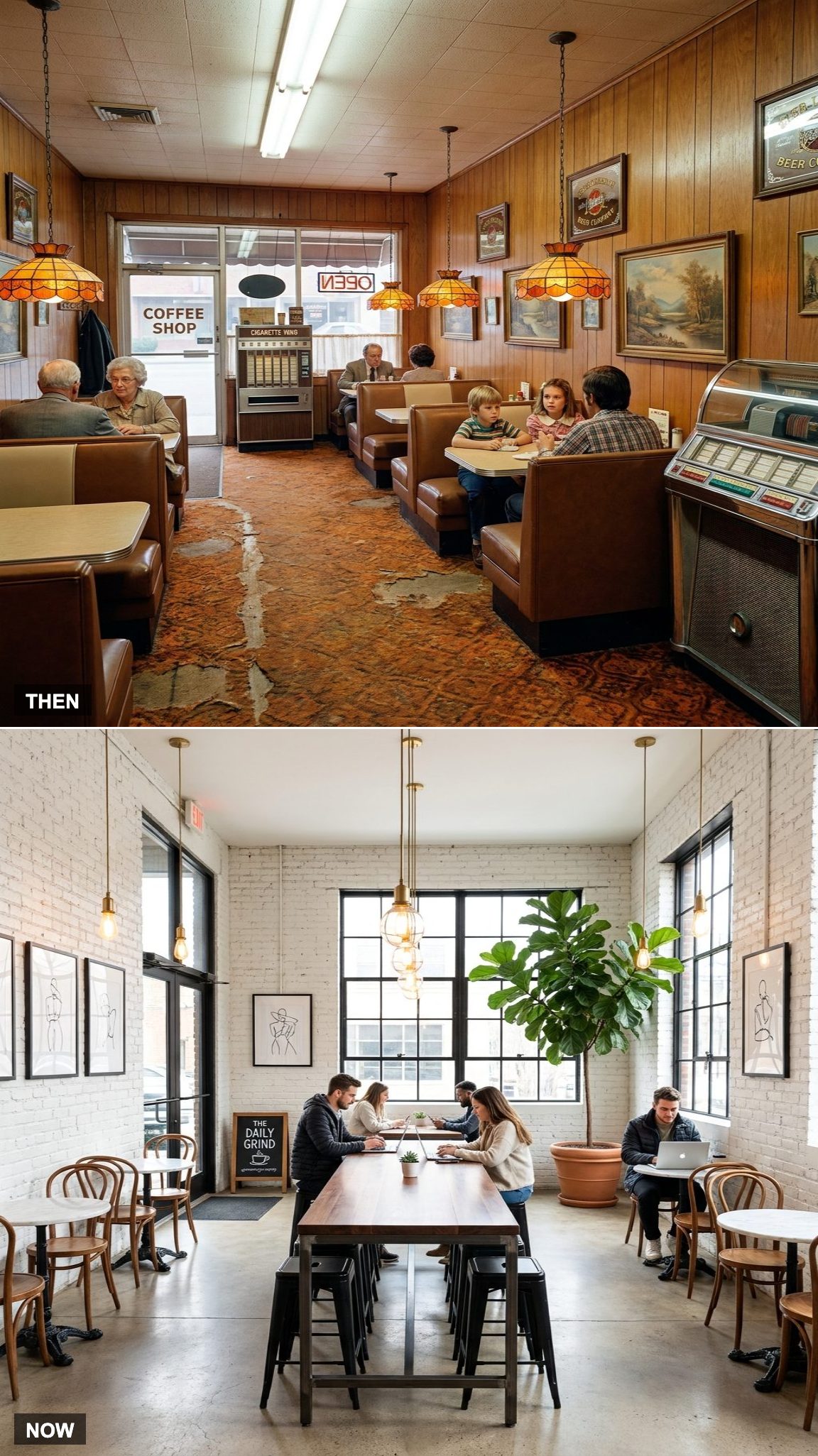
In 1975, the décor was whatever the previous tenant left plus whatever a beer distributor gave you for free. Nobody was building a mood board. The Tiffany lamp over the booth was there because it was on sale at the restaurant supply place in 1971, and the carpet was chosen for how well it hid coffee stains.
The modern café is a Pinterest board that opens at 6 a.m. Every element is chosen, sourced, and cross-referenced. The brass Edison pendants, the fiddle-leaf fig, the polished concrete: the room is not a container for the coffee. It is half the reason you came.
The Neighborhood Coffee Shop vs. the Portable Café Brand
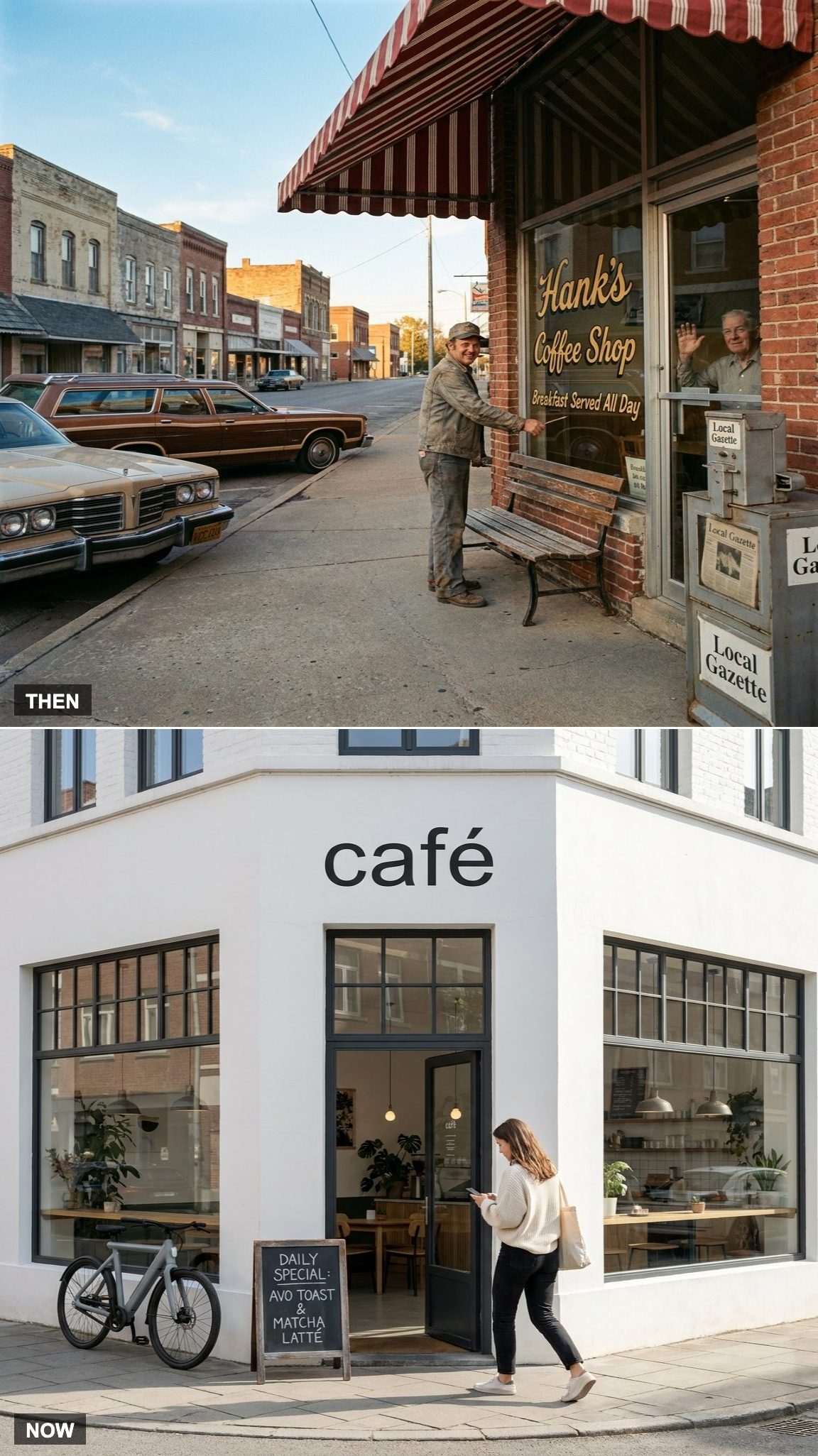
Hank’s Coffee Shop sat on the corner of Main and Second for forty years. Hank knew everyone. Everyone knew Hank. When Hank retired, the place closed, because Hank was the place.
The café that replaced it three years later has a one-word name in lowercase and a polished social feed. Lift the room whole and place it in Portland, Berlin, or Melbourne, and it would still make sense. The coffee may be better. The local fingerprints are harder to find. Most days the trade looks reasonable, and some days you still miss Hank.