Would you like to save this?
The automatic door still moved with the slow, mechanical hesitation of an early pressure-mat system. You walked into a 1970 supermarket and the air smelled like butcher paper, floor wax, and whatever the bakery had going in the back, all of it under the steady hum of fluorescent tubes overhead. A man in a paper hat weighed your chuck roast by hand and wrote the price in grease pencil. Half a century later the same trip involves self-checkout beeps and a produce wall that mists itself on a timer. Here’s how 31 parts of the grocery store changed.
31. Store Exteriors
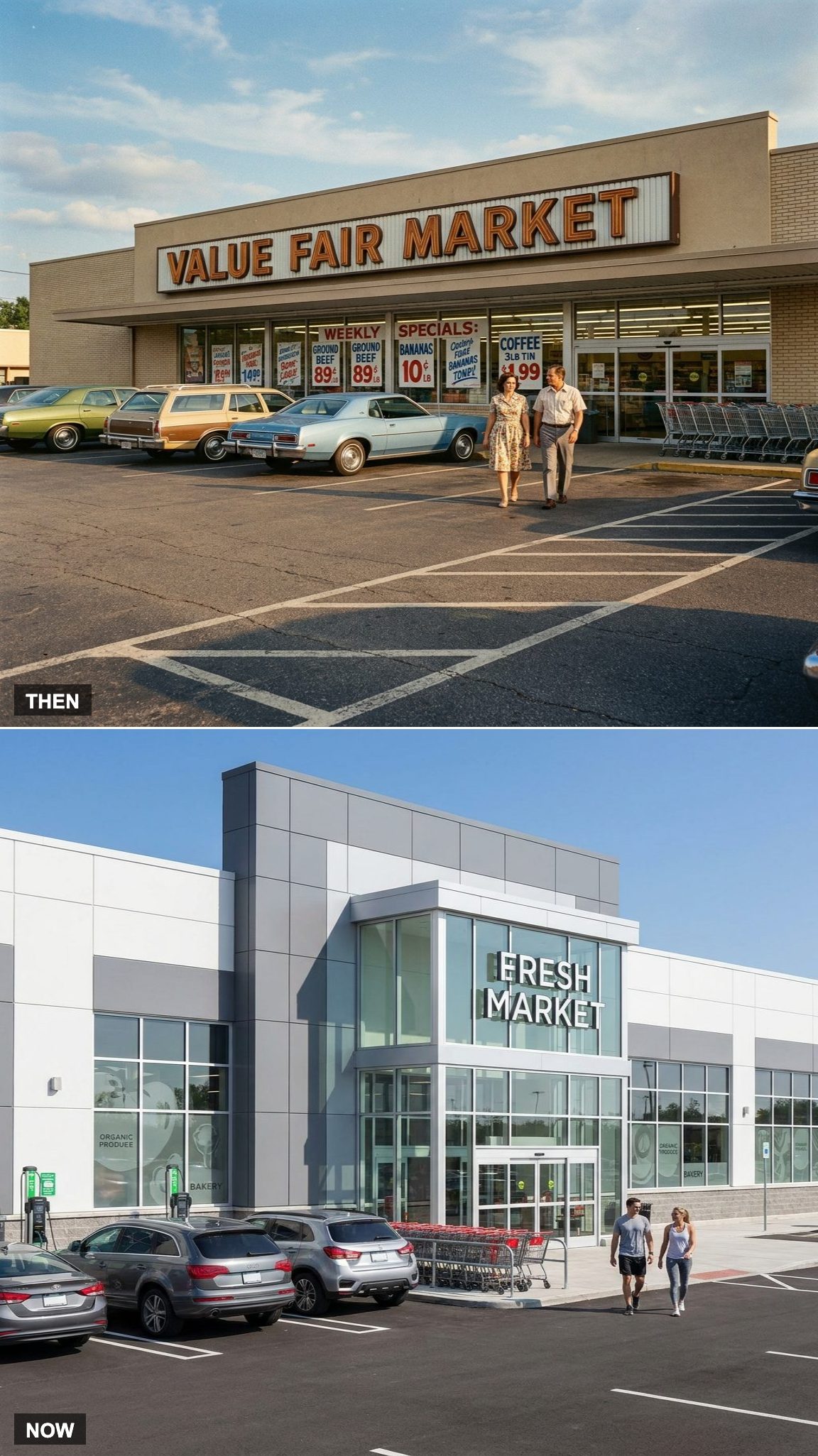
The 1970 supermarket announced itself with a marquee, backlit plastic letters in orange and brown that looked like they belonged on a bowling alley. And the windows? Buried under hand-painted specials, somebody’s whole afternoon spent lettering GROUND CHUCK 79¢ in red tempera.
Now the exterior whispers. Gray panels, a clean logo, and glass that stays clear because the deals live on an app. The building somehow feels both taller and quieter. Honestly, I miss the painted windows. There was a person behind that brush, and you could tell.
30. Store Entrances
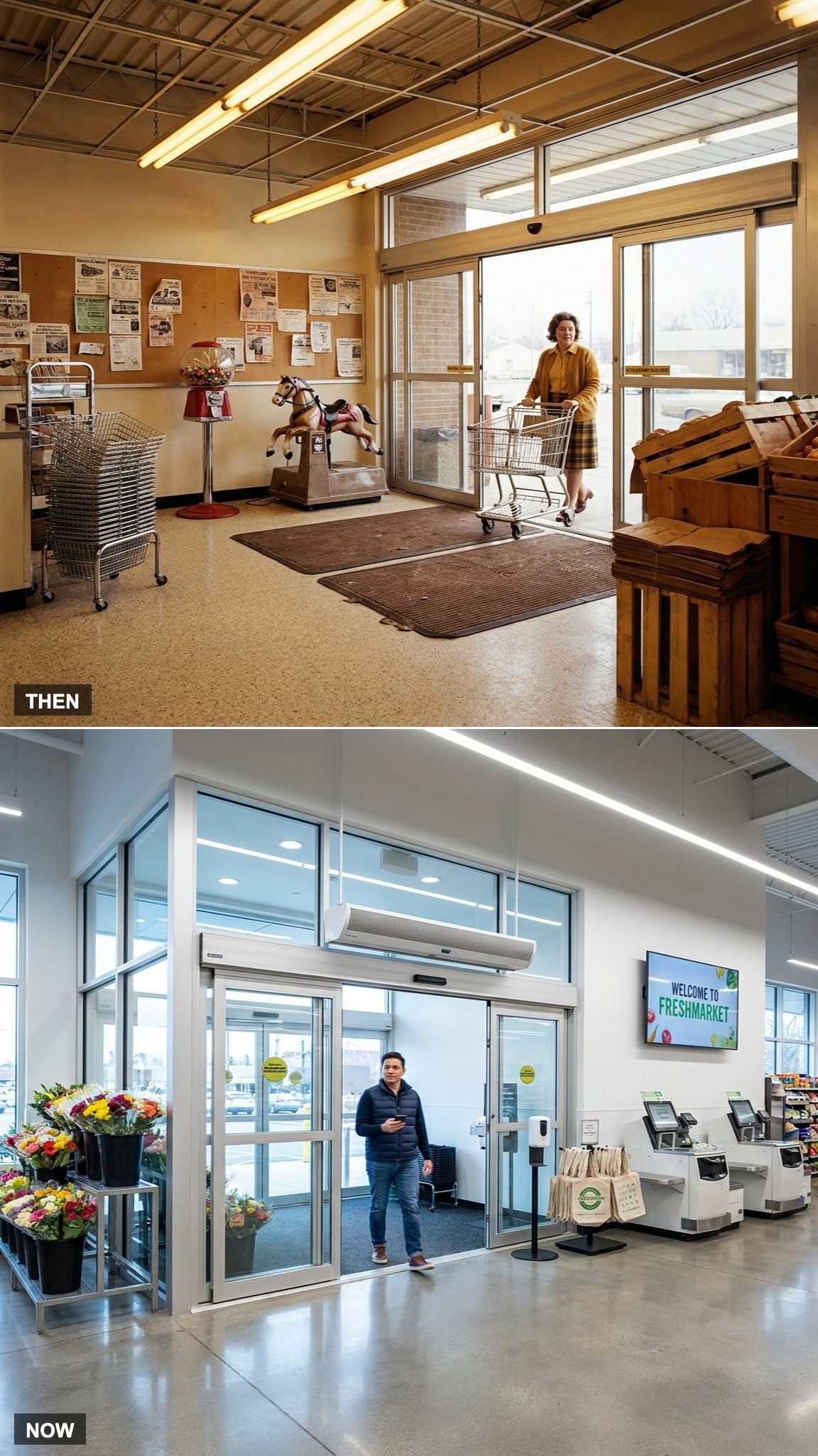
Step onto the rubber mat and the doors swung open like they were doing you a favor, slow and mechanical and a little grudging. Just past them sat a coin horse for the kids and a gumball machine, both positioned to catch you before the first aisle.
The modern entrance moves faster and says less. Sliding glass, a wall of flower buckets, a screen flashing today’s app-only price. Efficient. Also a little lonely, because far fewer handwritten notices are pinned near the entrance.
29. Shopping Carts
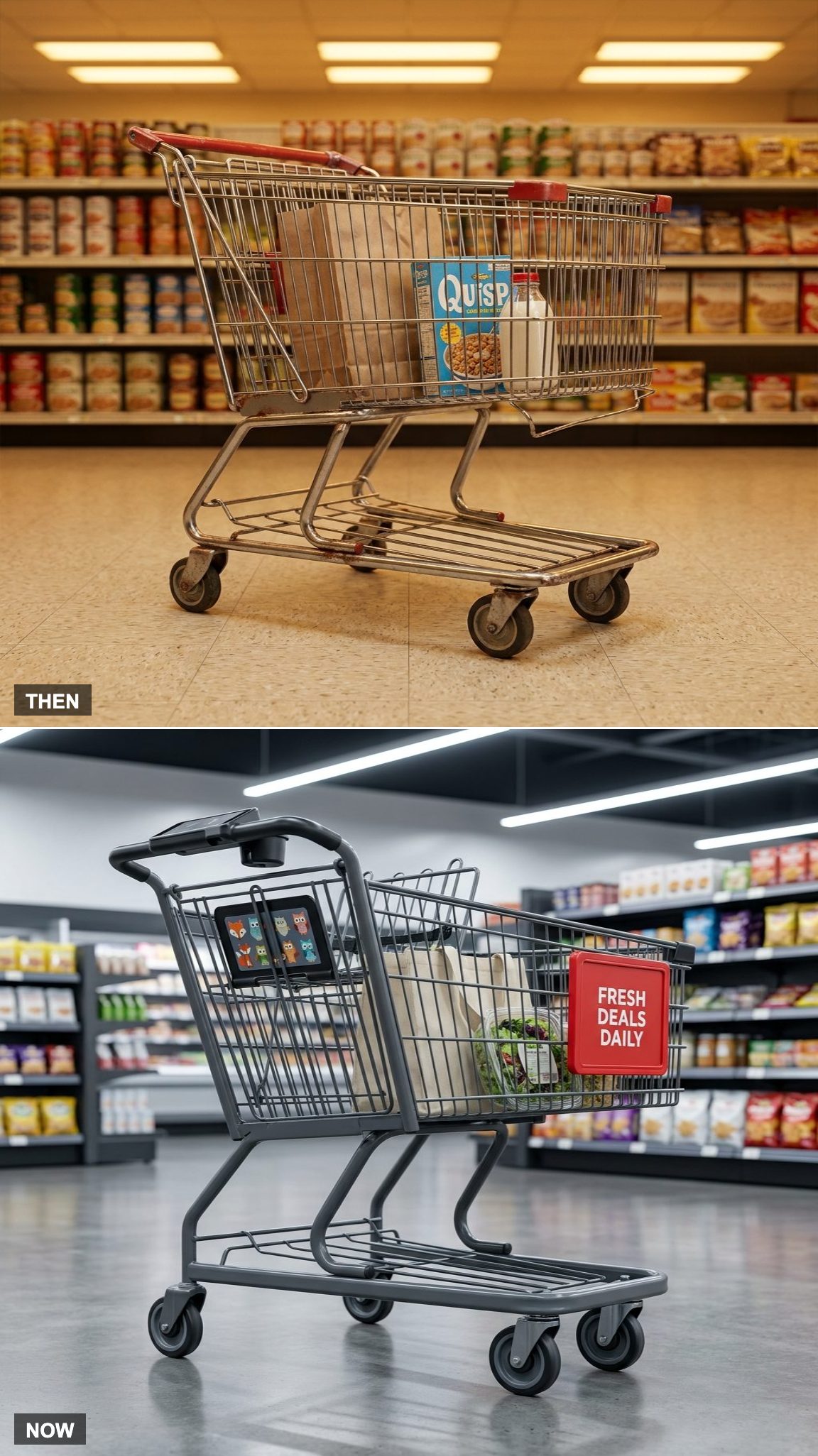
All chrome, all business. The 1970 cart was a wire basket on hard rubber wheels, and every one of them had a personality: the one that pulled left, the one with the squeak, the one whose wheel spun sideways the whole trip. And the kid seat folded down and pinched fingers with zero remorse.
Today’s cart has a cup holder and a place to prop your phone. Smoother wheels, an ad panel on the front, cartoon graphics on the seat. It works better. It just doesn’t fight you anymore, and I sort of miss the fight.
28. Shopping Baskets
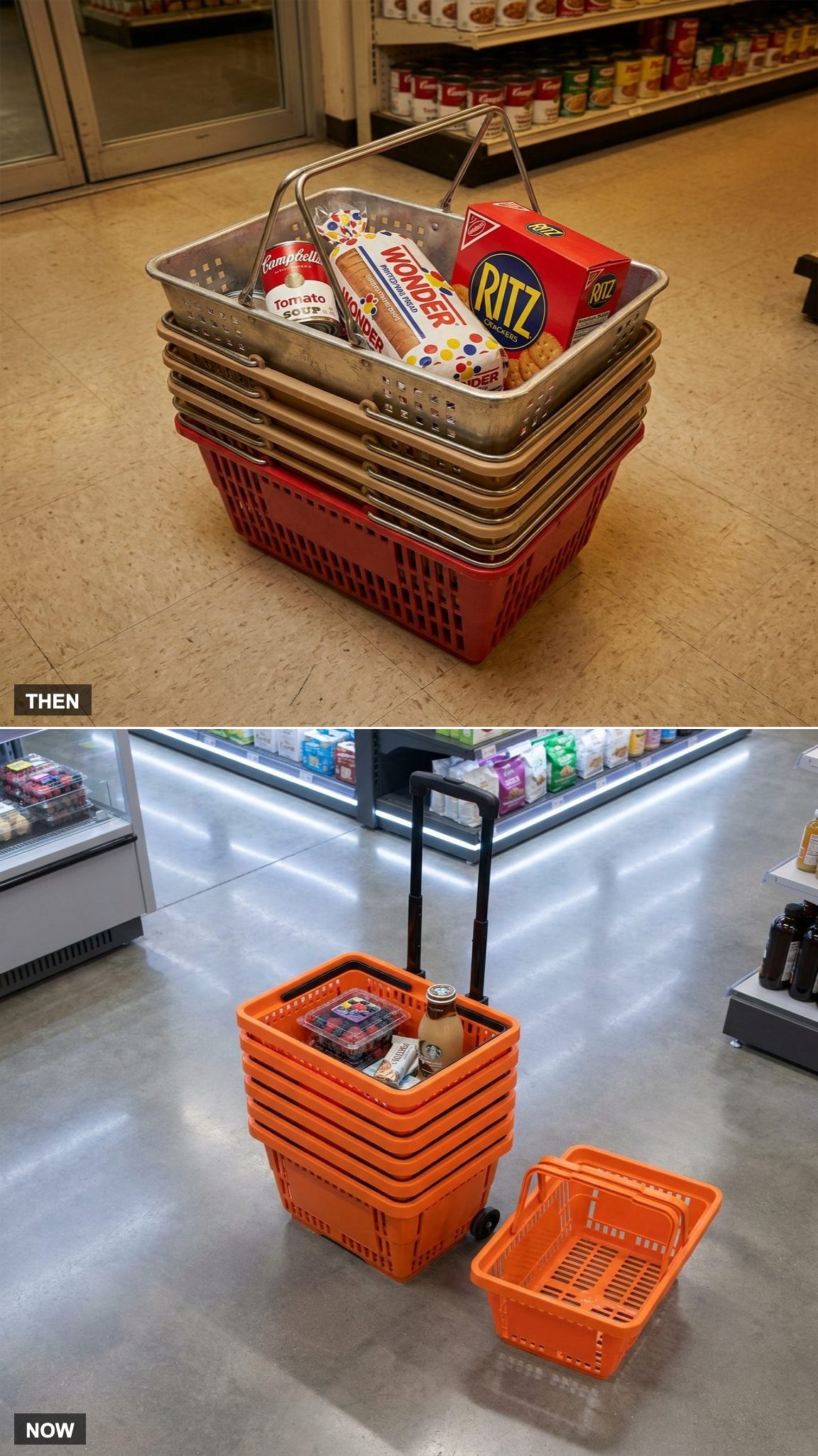
Heavy little things. The 1970 hand basket was stamped aluminum or thick red plastic, two metal handles that folded over the top and dug lines into your palm by the time you hit the register. You filled it with a soup can and a loaf of bread and your arm knew about it.
Now the basket has wheels and a pull handle like carry-on luggage. Lighter, roomier, easier on the shoulder. Progress, sure. But here’s a small confession: the old ones felt like you were carrying groceries, and these feel like you’re at the airport.
27. Produce Departments
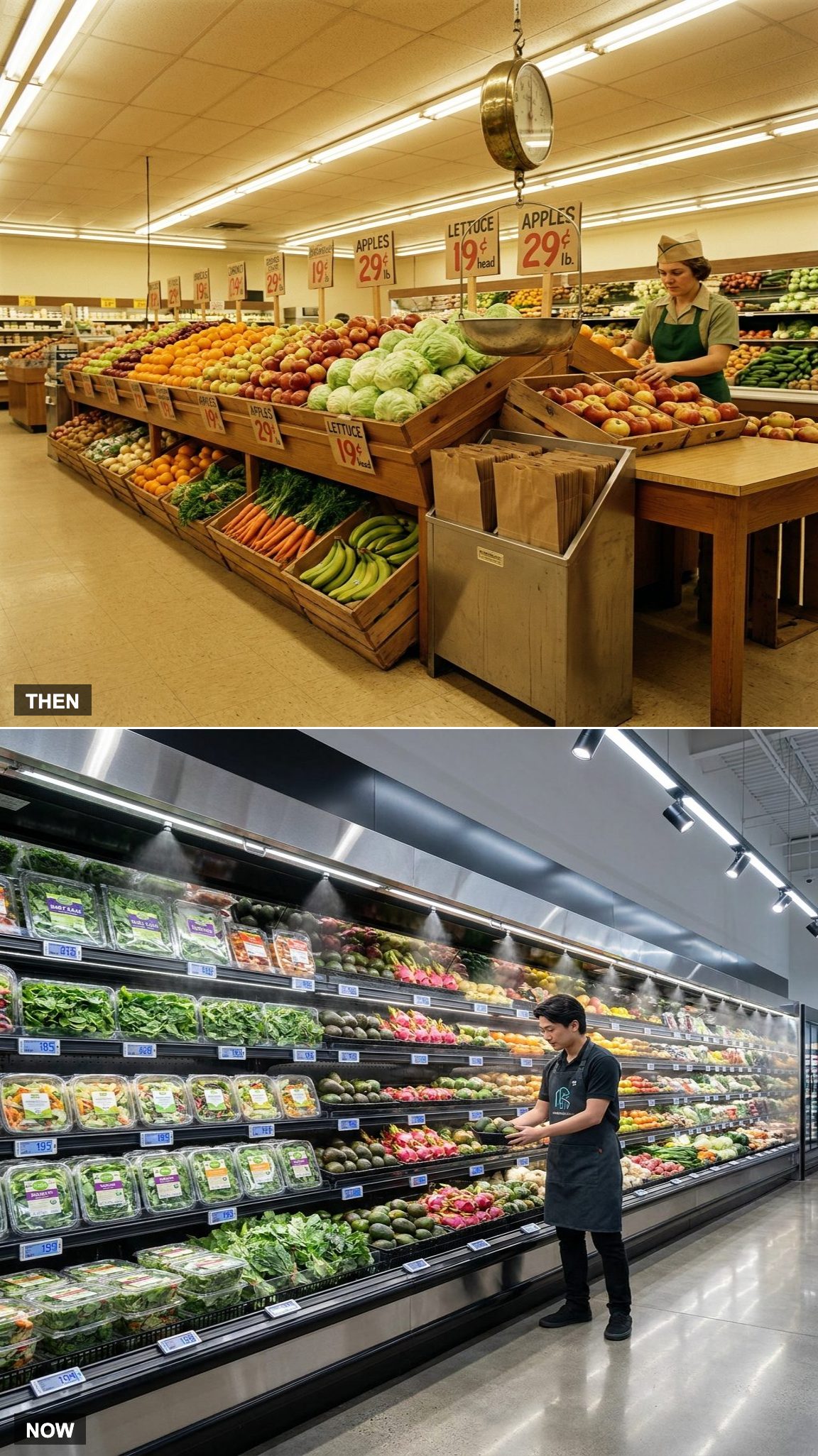
Iceberg lettuce, apples, oranges, carrots with the dirt more or less still on the tops. The 1970 produce section offered a narrower selection that was more closely tied to season and region, although commercial distribution was already extending availability. Wooden bins and grease-pencil prices still made the department feel much closer to the loading dock.
The modern wall mists itself on a timer and offers dragon fruit next to five kinds of kale, twelve months a year. More choice, less waiting for June. The trade is less about one era having perfect tomatoes than about modern produce being selected and shipped for year-round availability, durability, and distance.
26. Meat Counters
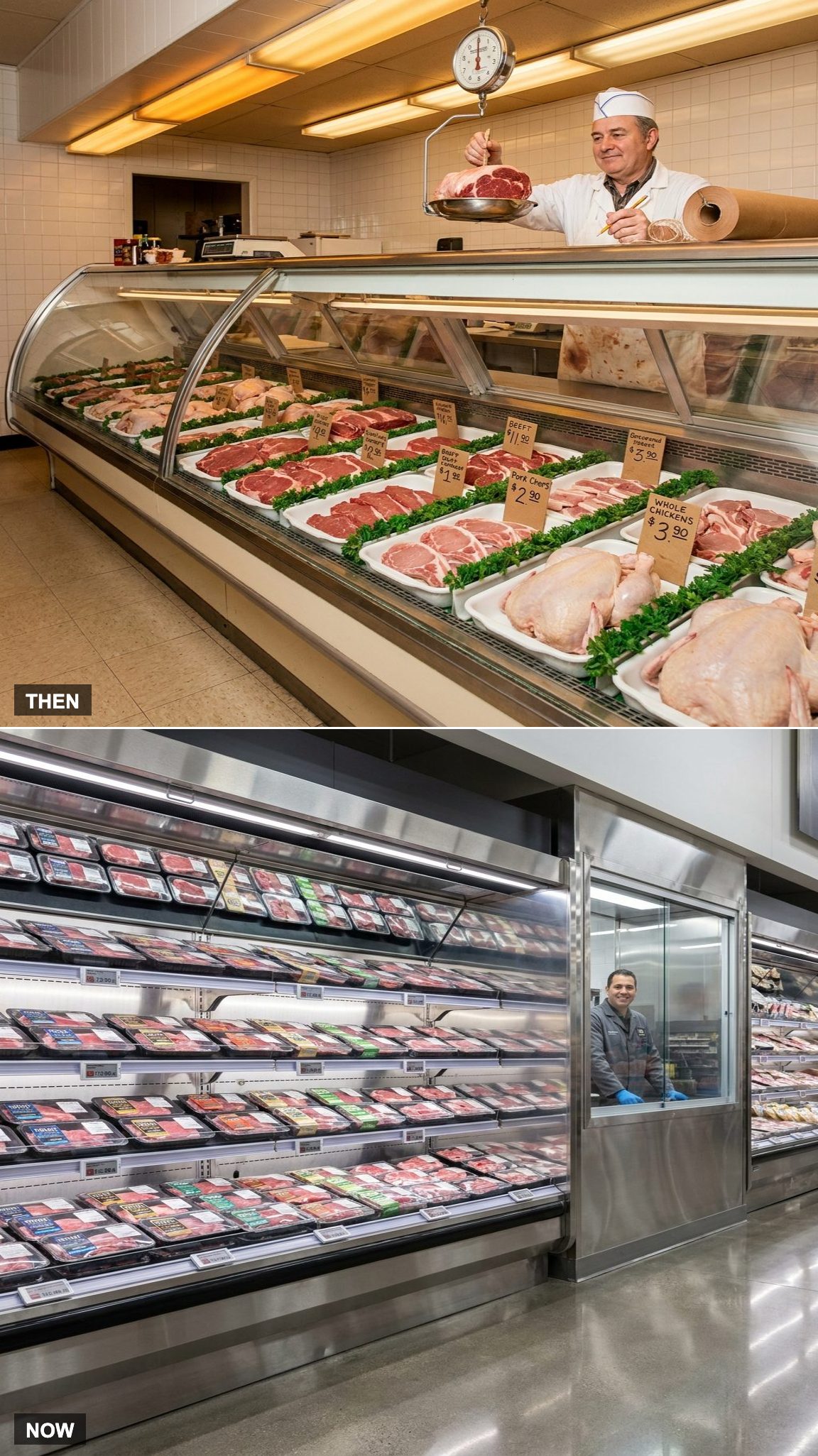
You waited for the meat. Took a number, watched a man in a paper hat pull a roast, weigh it on the hanging scale, wrap it in brown paper and tie it off with string, and cut a steak to whatever thickness you asked. He knew your name and which cut your family usually ordered.
In many stores, much of that counter space has been replaced by shrink-wrapped trays with barcodes, LED lighting, and self-service cases. Faster. But the butcher who would grind a special blend or bone out a chicken while you waited? That service is often limited to one small staffed window now, when it is available at all.
The full-service meat counter wasn’t a department. It was a relationship, wrapped in butcher paper and tied with string.
25. Seafood Counters
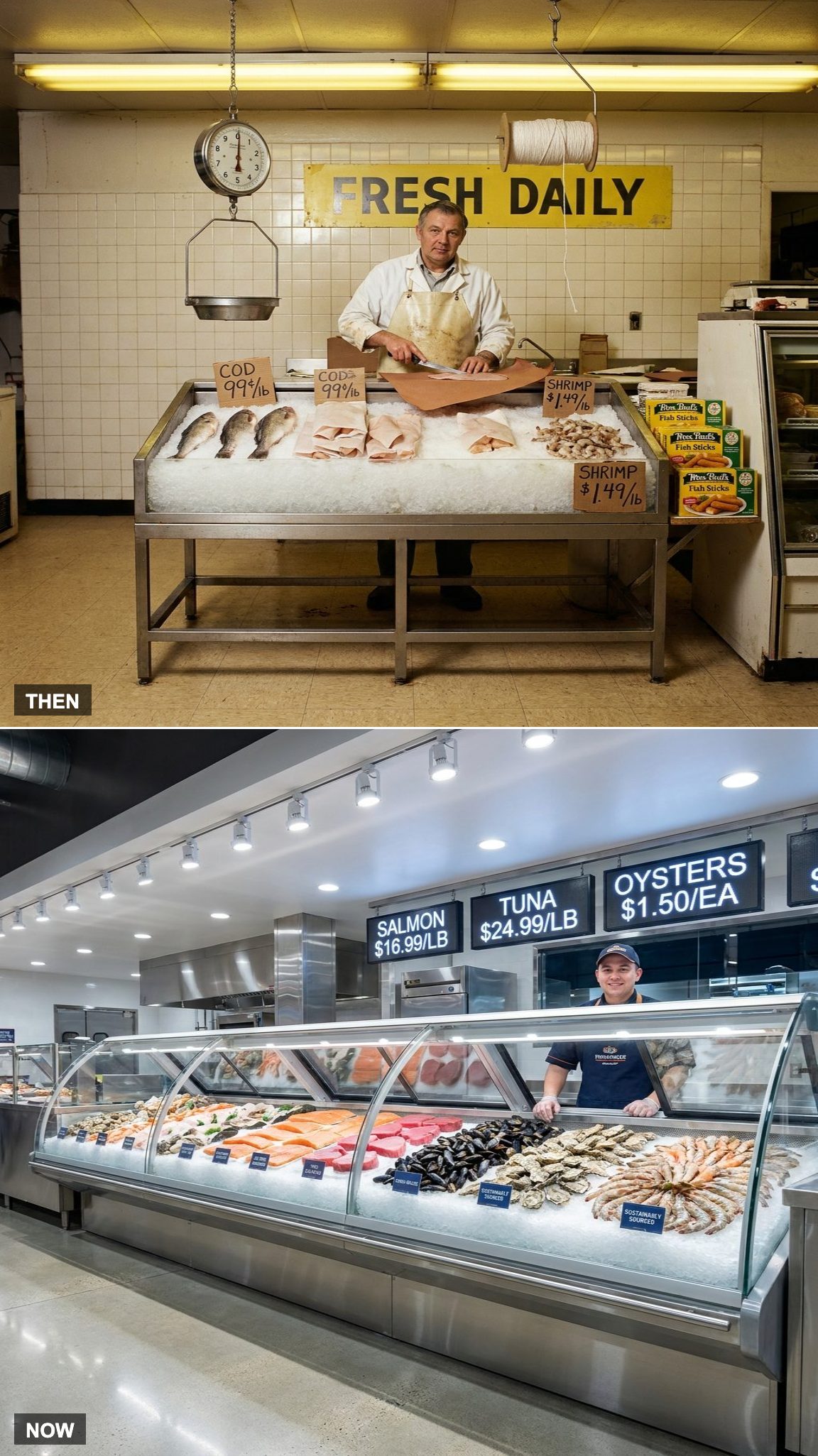
In many inland supermarkets, seafood meant frozen fish and perhaps a modest iced case stocked with whatever had arrived that week. Shrimp was a treat, and fresh salmon was far less routine than it is now.
A larger modern store may offer oysters, tuna steaks, prepared sushi, and seafood brought in from distant markets under bright case lighting. The range can be a genuine upgrade, especially far from the coast. The 1970 shopper would’ve stared at those oysters like they were spacecraft.
24. Delicatessens
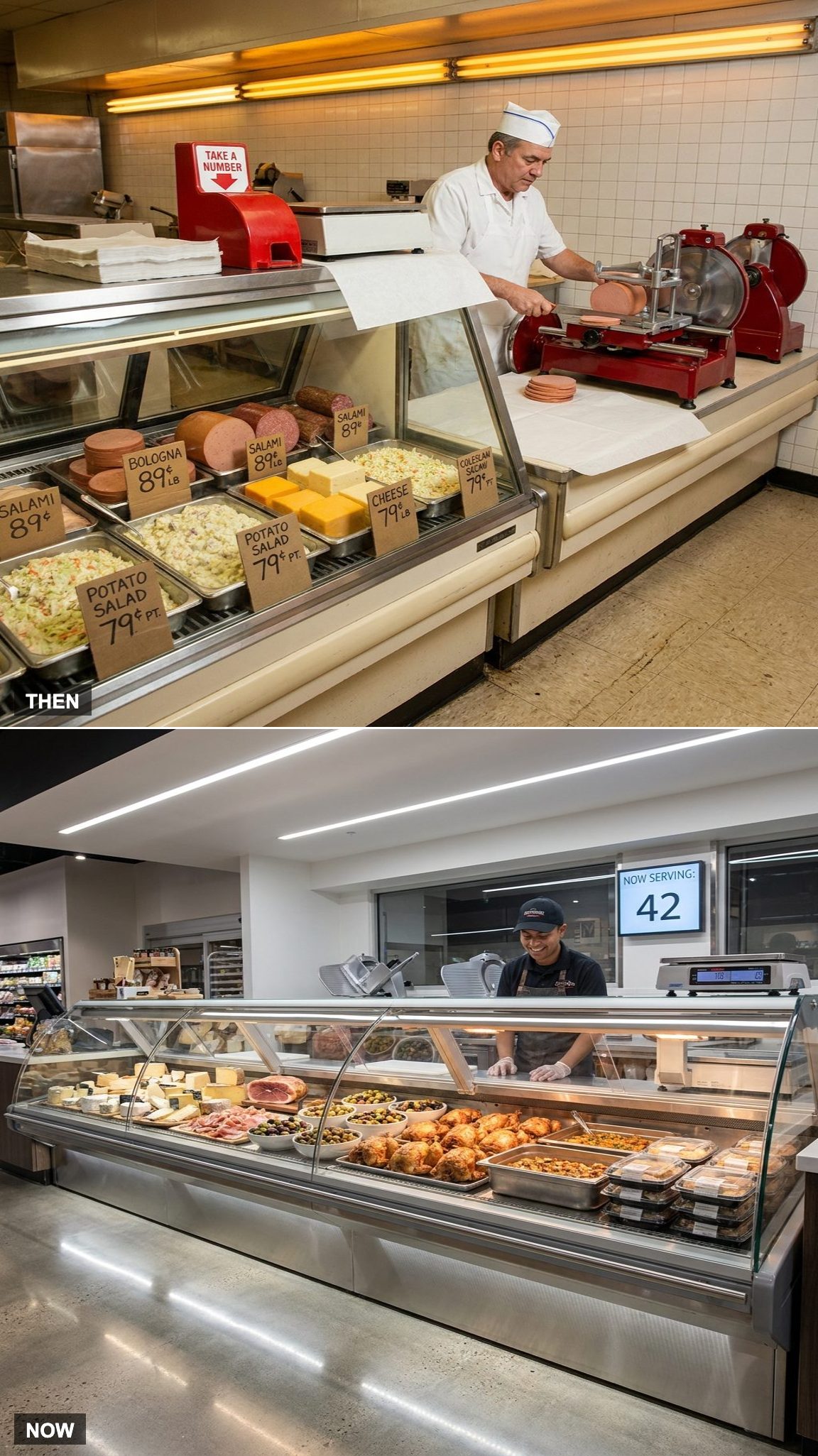
Take a number. The 1970 deli was a red slicer, a case of bologna and American cheese, a metal pan of potato salad, and a worker who’d shave your lunch meat to whatever thinness you demanded and hand you a slice to taste, wrapped in white waxed paper, folded twice and taped once.
Now the service case may run the length of a wall, with prosciutto, olives, regional cheeses, and far more sliced meats than the old bologna-and-American-cheese lineup. The number ticket survived. Everything around it got fancier. And the free taste slice, thankfully, mostly survived too.
23. In-Store Bakeries
Would you like to save this?
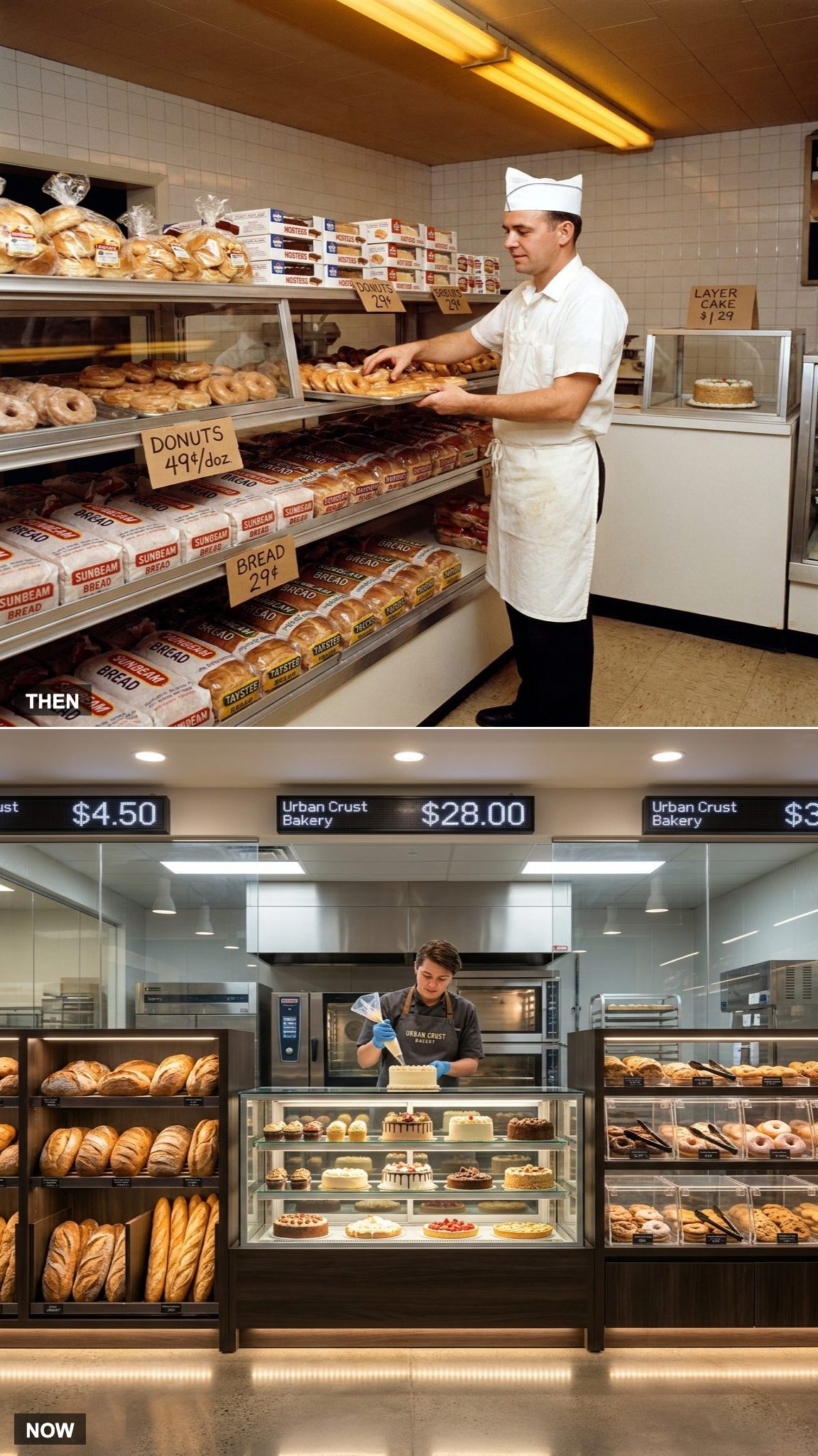
In many 1970 supermarkets, much of the bakery selection came in off a truck: wax-paper white bread, boxed layer cakes, glazed donuts on a tray under a plastic cover. If the store baked at all, it baked in the back, out of sight, and the smell was the only proof.
Modern bakeries turned the ovens toward the aisle. You watch the bread come out. Self-serve bins of cookies and croissants, custom cakes piped to order, a wall of sourdough. The smell functions like a marketing department now. An effective one, too. Nobody walks past warm bread on purpose.
22. Dairy Aisles
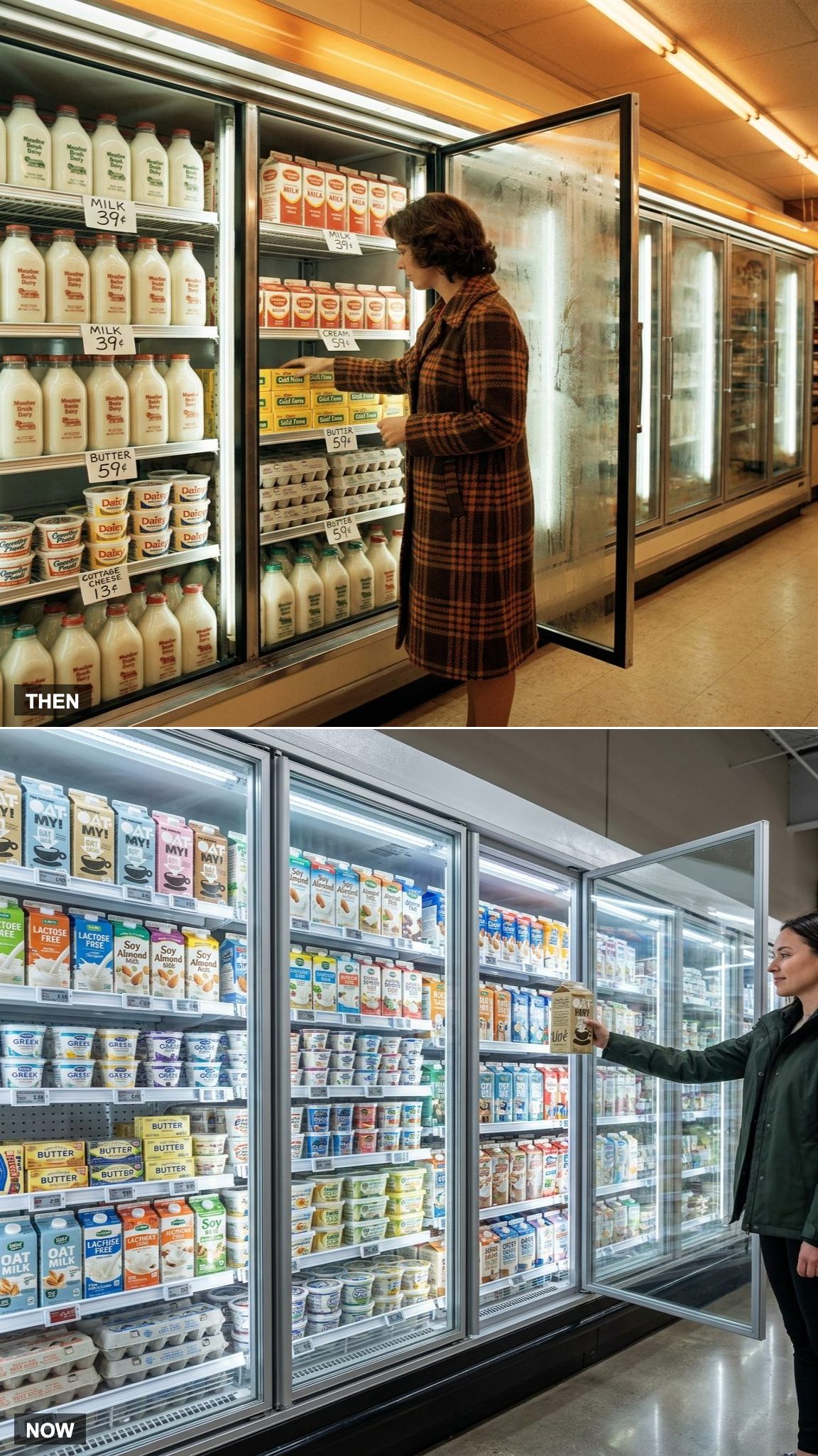
The dairy wall was smaller: whole, 2 percent, skim, and perhaps buttermilk in glass bottles, waxed cartons, or plastic jugs. Then came butter, margarine, cottage cheese, and eggs. A dozen decisions, made in under a minute.
Now the same stretch offers oat, almond, soy, lactose-free, and four fat percentages of the regular stuff, plus Greek yogurt in flavors that didn’t exist. It takes longer to buy milk than it used to take to buy dinner. More options, sure, and more standing there reading labels in the cold.
21. Frozen Food Sections
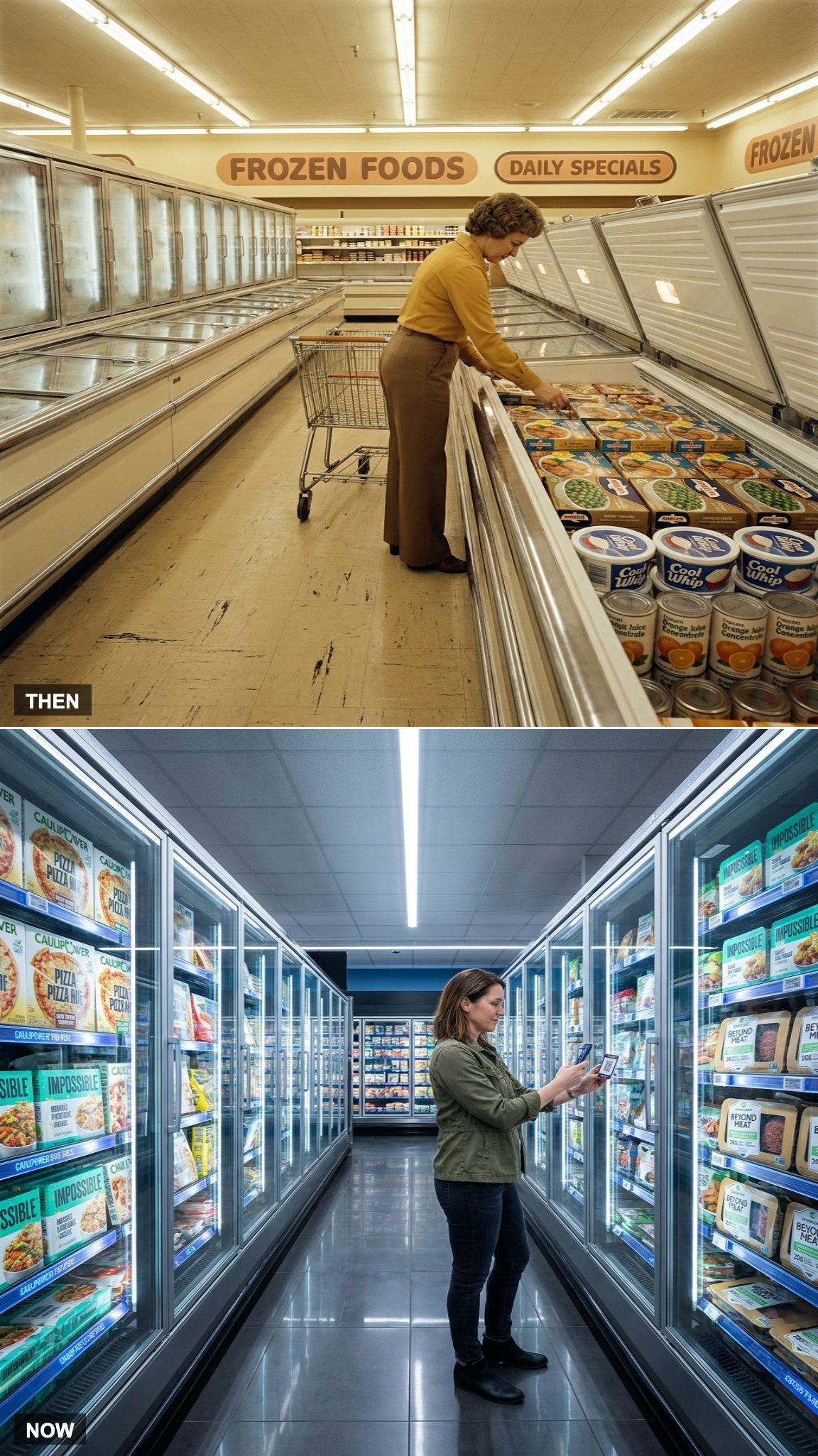
You lifted the fogged glass lid and cold air rolled out over your wrist like a little ghost. Swanson dinners in their foil trays, Birds Eye peas in waxed boxes, orange juice in a can you thawed on the counter. The freezers hummed low and yellow under buzzing tubes, and the whole section smelled faintly of frost and cardboard.
Now it’s a glass wall of upright doors, LED-white and glowing, electronic shelf labels along the edges. Cauliflower crust. Plant-based everything. Meals that photograph better than they taste. The doors may fog briefly when you open them, then clear through heated glass and airflow systems—efficient, and cold in more ways than one.
20. Cereal Aisles
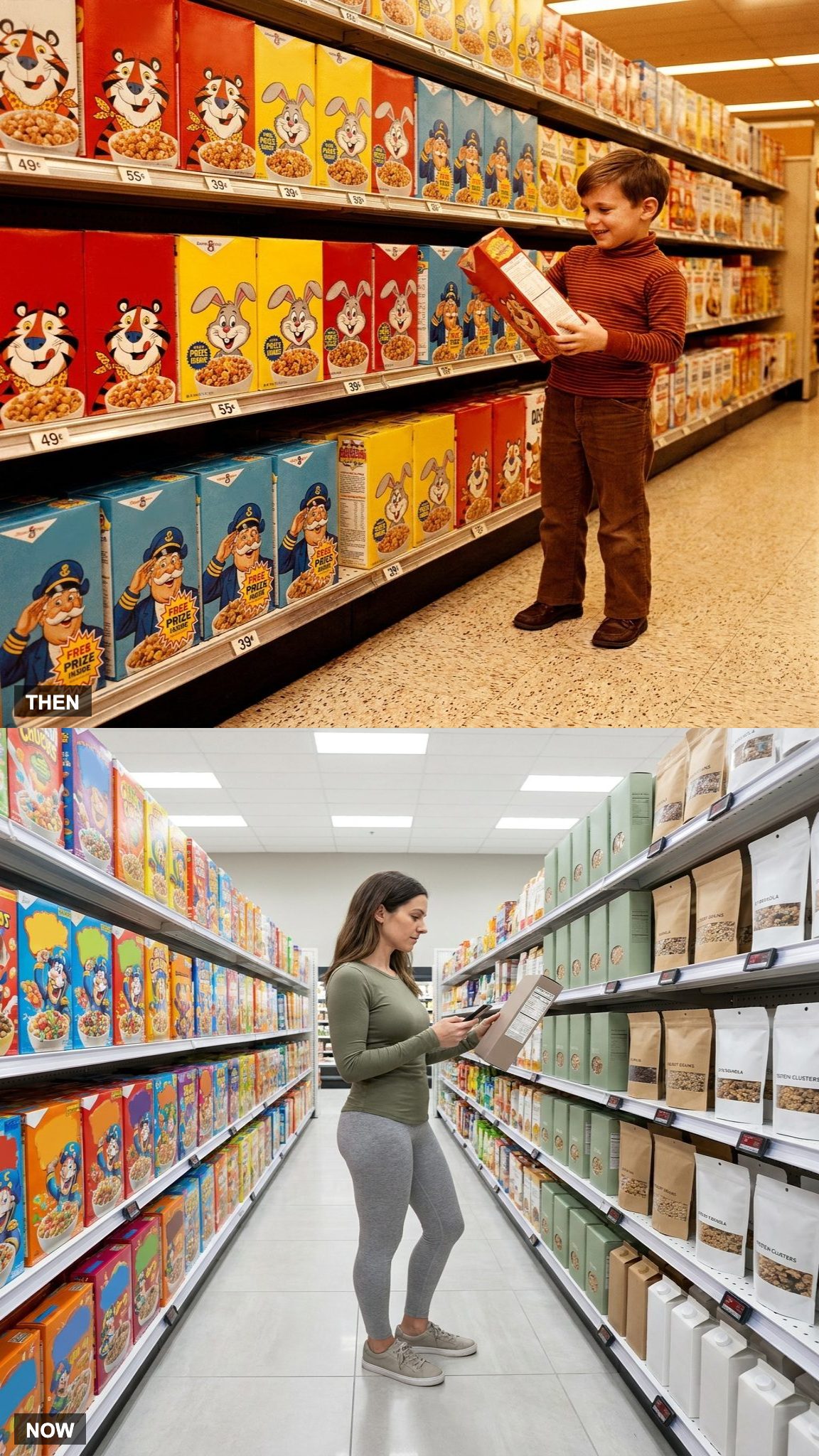
The cereal aisle in 1970 was a wall of cartoon faces at kid height, and that was no accident. Tigers, rabbits, sea captains, all painted to grab a seven-year-old by the eyeballs and hold on. And the prize? Buried in the flakes, so you’d tip the whole box sideways trying to shake it out before your mother caught you.
Today half the shelf still shouts at children. The other half whispers to their parents—granola in kraft paper, protein clusters, ancient grains in muted sage packaging. Same aisle, two audiences, and the digital price tags flicker while nobody watches.
19. Beverage Aisles
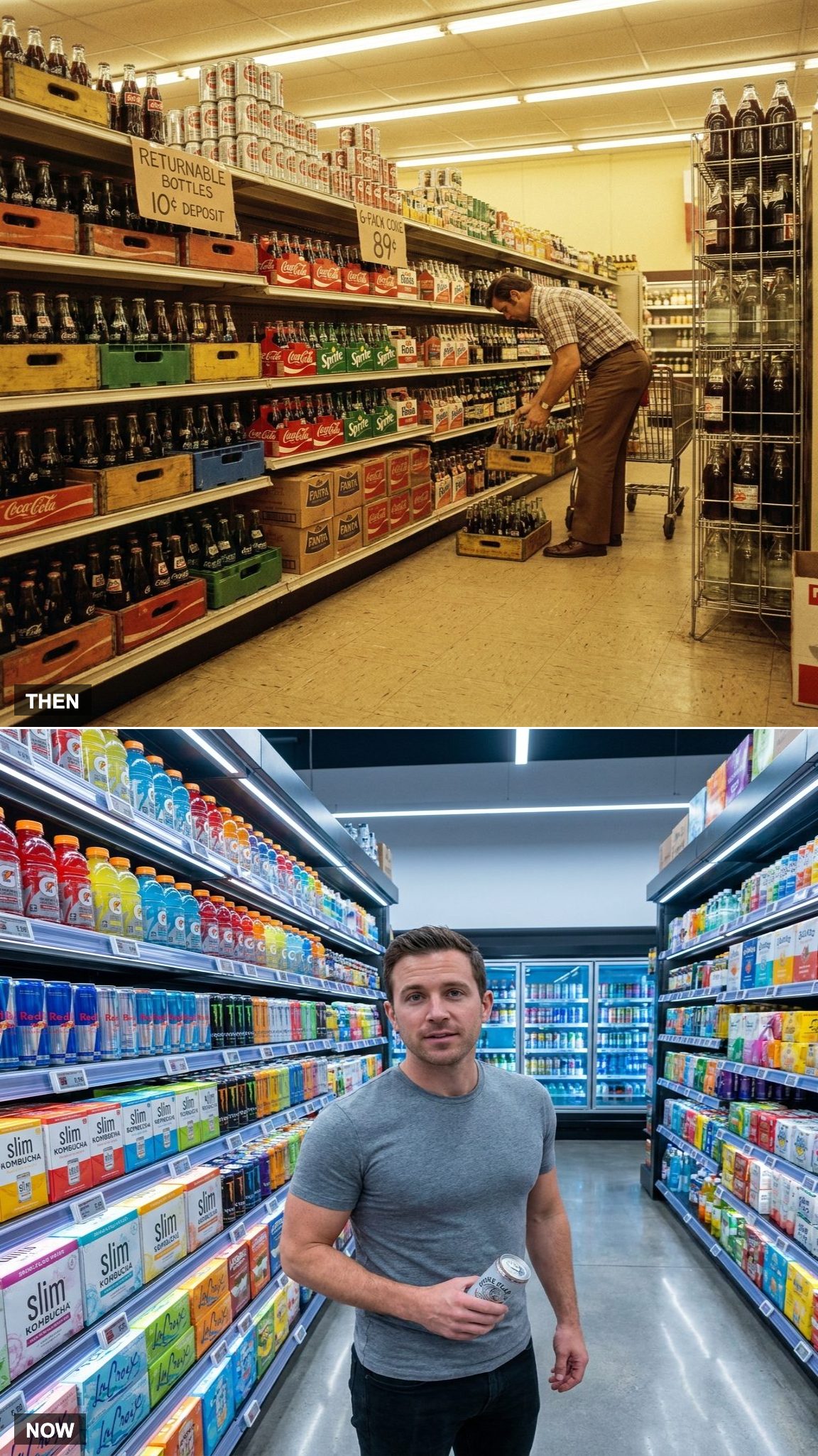
Soda came in glass in 1970, and glass came with a deposit. You hauled the empties back in a wooden crate that clinked the whole drive over, and the store handed you a few cents a bottle like it was doing you a favor. Six-packs sat in cardboard carriers with finger holes worn soft. The pull-tab can was the exciting new thing, and you left the tabs everywhere—in the grass, in your pocket, in the cushions of the car seat.
Walk it now and it’s a color riot. Energy drinks, seltzers, kombucha in slim cans, twelve kinds of water that all taste like water. Returnable glass has largely given way to cans and plastic bottles, although deposit systems remain in some states. Much of the packaging is recyclable in theory; whether it reaches a recycling facility is another question.
18. Checkout Lanes
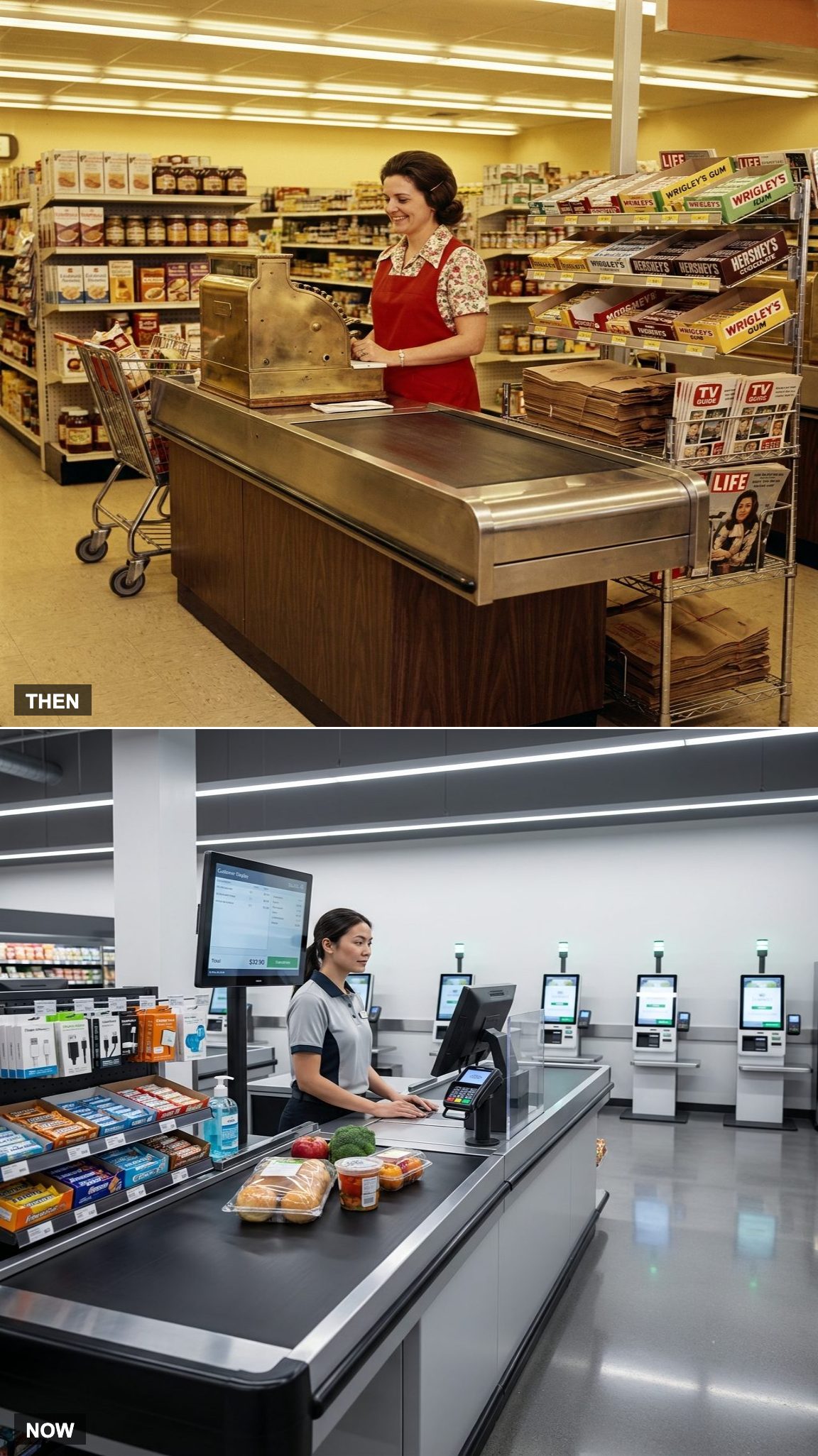
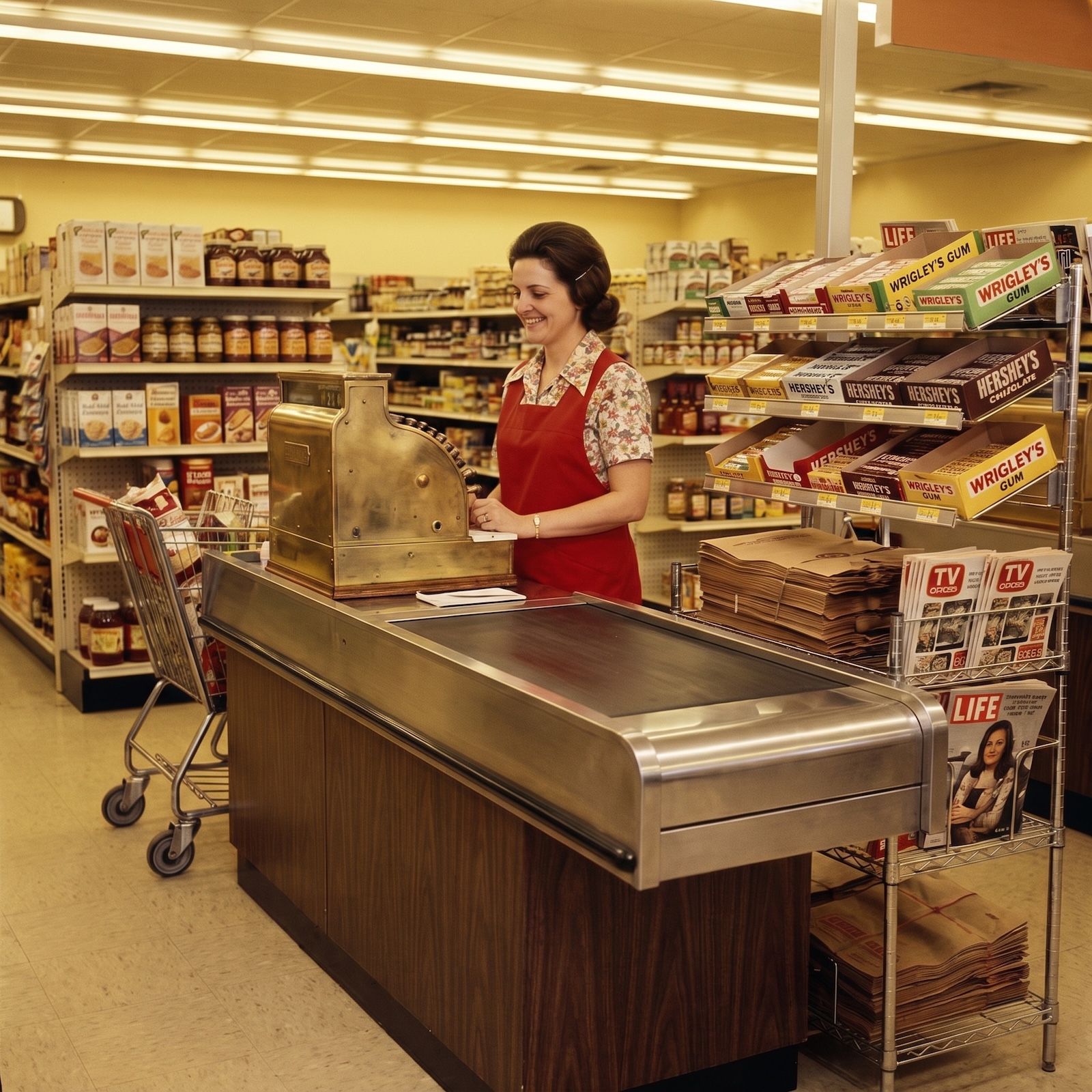
The checkout lane in 1970 ran on human hands and a conveyor belt you nudged forward yourself. The cashier memorized many common prices and read the rest from stamps or stickers, punching them in fast with an apron on, TV Guide and Juicy Fruit stacked at elbow height to catch you while you waited. Paper bags stood open on a wire rack behind her, ready.
Now the lane hums with screens. Tap your card and watch a display suggest a lottery ticket while nearby self-checkout kiosks handle shoppers who would rather scan and bag for themselves. The impulse rack still exists—it just sells phone chargers now.
17. Cash Registers
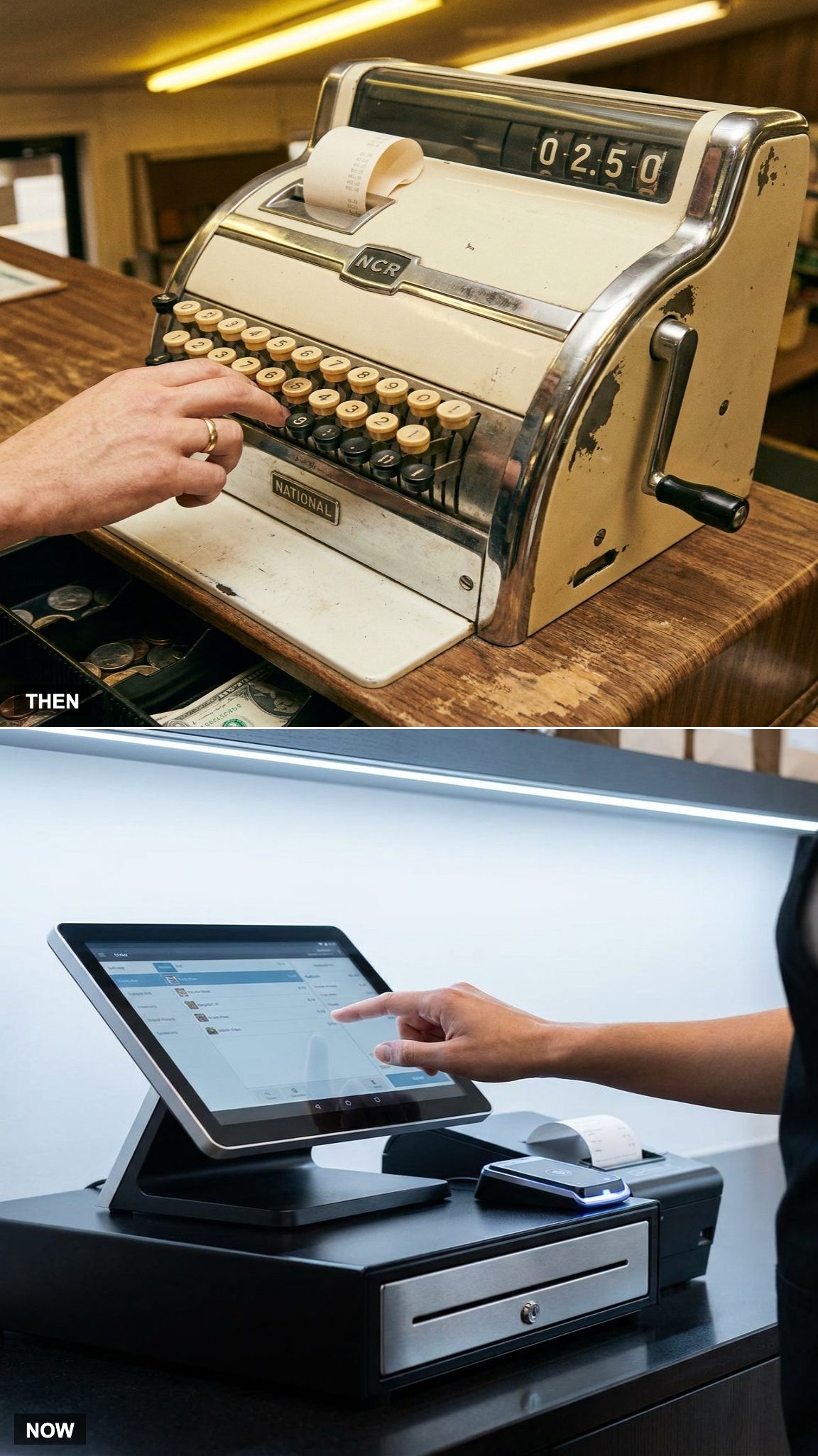
A 1970 register could be heavy enough to need two people to move it—cream enamel, chrome trim, firm keys, and a display window that showed the running total. The drawer shot open with a bell everyone in the store heard. The cashier counted change in her head rather than relying on the machine to calculate it.
The modern version is a black glass rectangle. Tap, beep, done. No bell, no crank, no satisfying mechanical thunk. It does far more while revealing almost none of its machinery.
16. Price Tags
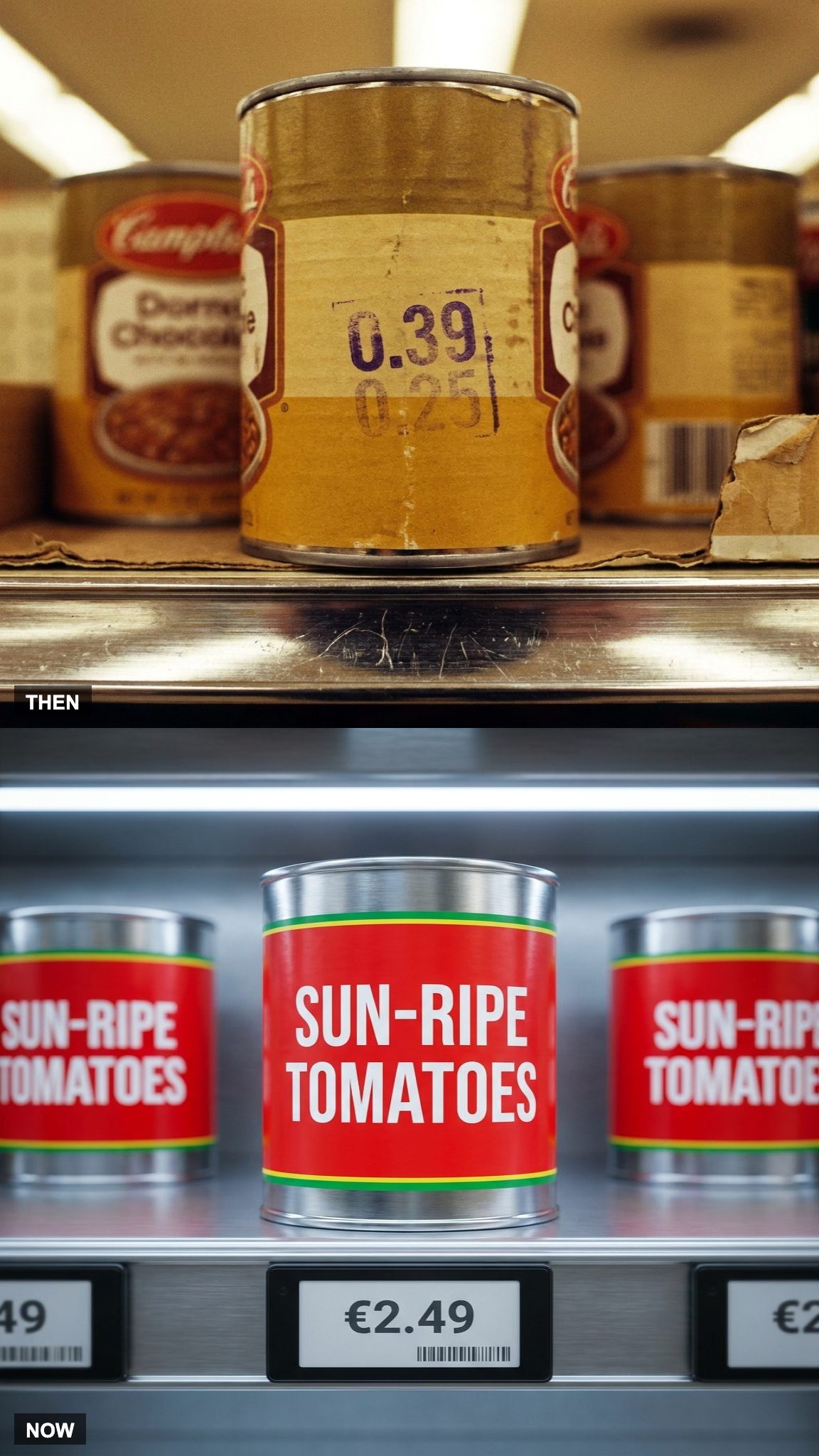
Every can wore its own little purple bruise in 1970—a price stamped on in violet ink from a handheld gun that a stock clerk clicked down the aisle all afternoon. You peeled them off with a thumbnail at home and they left a gummy shadow. When prices rose, somebody re-stamped over the old number, and if you looked close you could sometimes read both.
Now the tag lives on the shelf edge, an e-ink display that changes from a back office in seconds. No sticker. No ink. No thumbnail archaeology. Convenient, sure, because a price can be updated across the store without anyone replacing a paper label.
15. Barcode Scanners
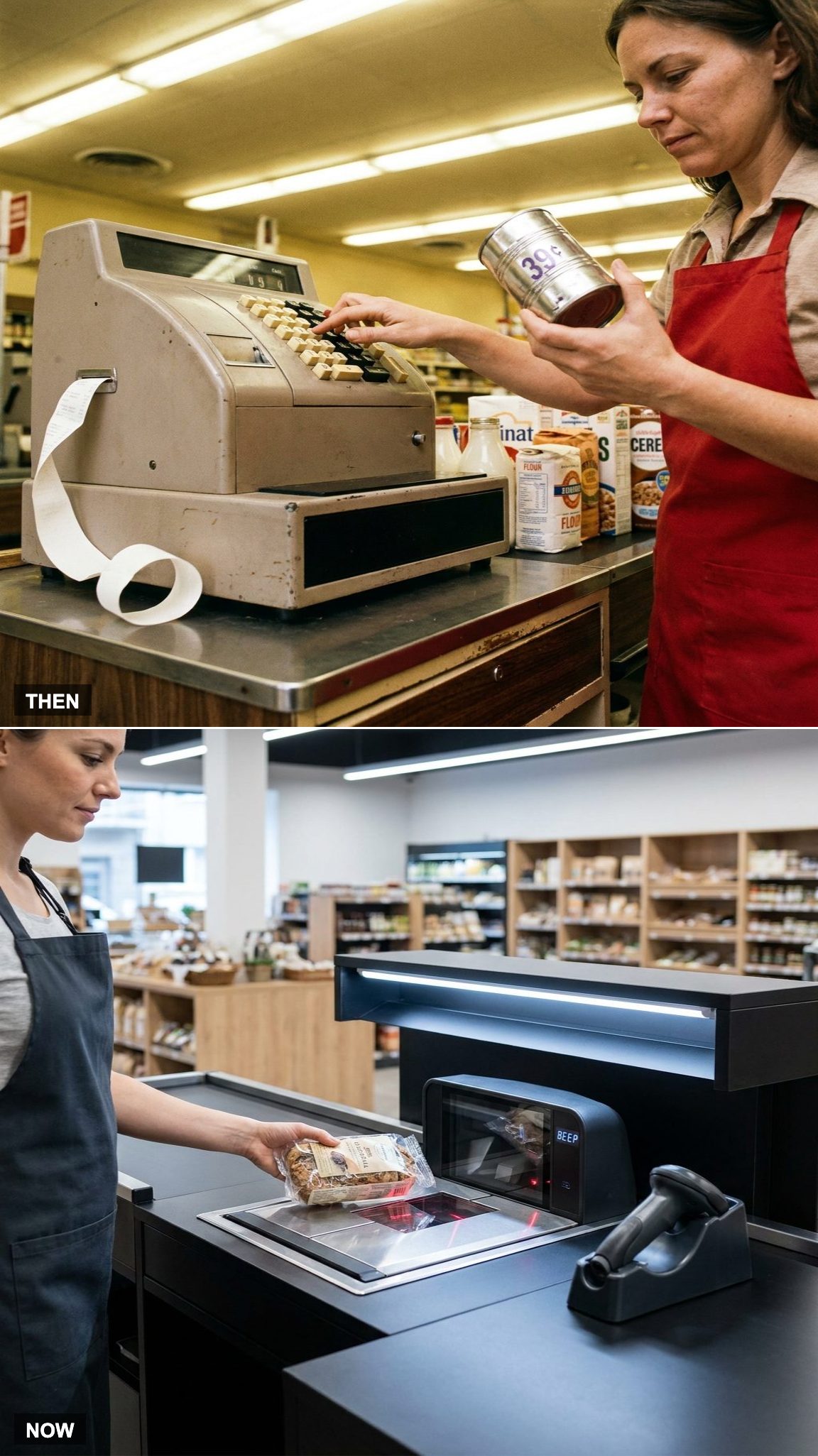
In 1970, a supermarket checkout scanner was not yet part of the ordinary shopping trip. The cashier read the stamped price with her eyes and keyed it in, one item at a time, fast enough that you barely noticed. Mistakes happened. So did the little thrill when she caught a wrong price and fixed it in your favor.
The first product ever scanned by barcode was a pack of Wrigley’s gum in Ohio in 1974, and the familiar scanner beep soon became part of the checkout soundtrack. The red scanner flashes over item after item now, the total updates itself, and nobody reads a price out loud anymore.
14. Bagging Stations and the Paper Bags That Went Home With You
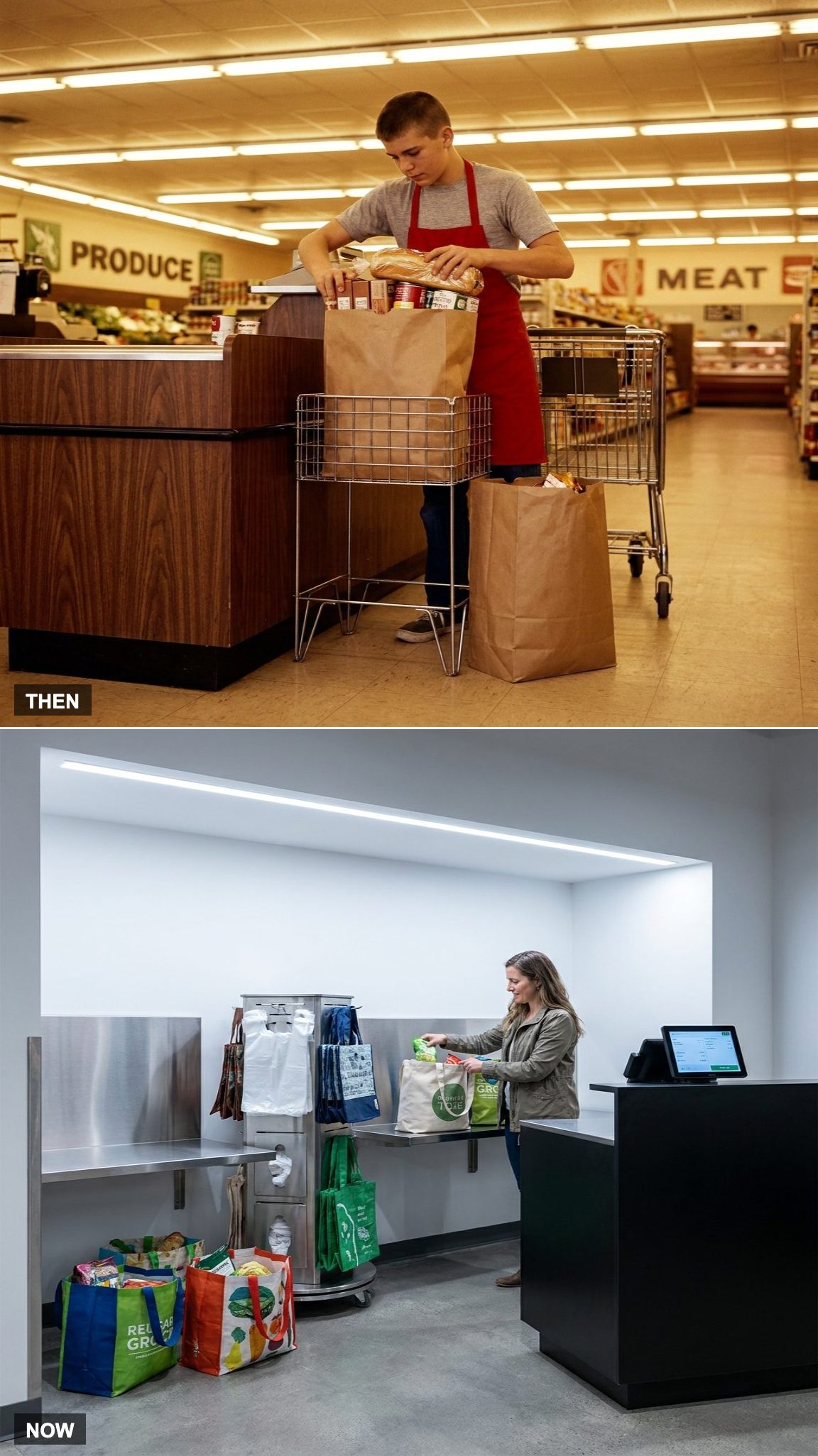
Bagging in 1970 was a craft, and a teenager in a red apron was trained in it. Heavy cans low, bread and eggs riding on top, weight balanced so the paper wouldn’t split on the walk to the Buick. He’d ask paper or, well, paper, and he’d carry it out to your car if you looked like you needed a hand. That was part of the job.
At self-checkout and in many understaffed lanes, shoppers now do much of the bagging themselves. Reusable totes are opened on a steel shelf, while the balance of cans, eggs, and bread becomes entirely your problem.
The old brown paper sack had a second life at home: book cover, puppet, trash-can liner, or a stack under the sink. Reusable bags are sturdier in other ways, but they do not stand open and hold their shape quite like a well-folded paper bag.
13. Store Lighting
Would you like to save this?
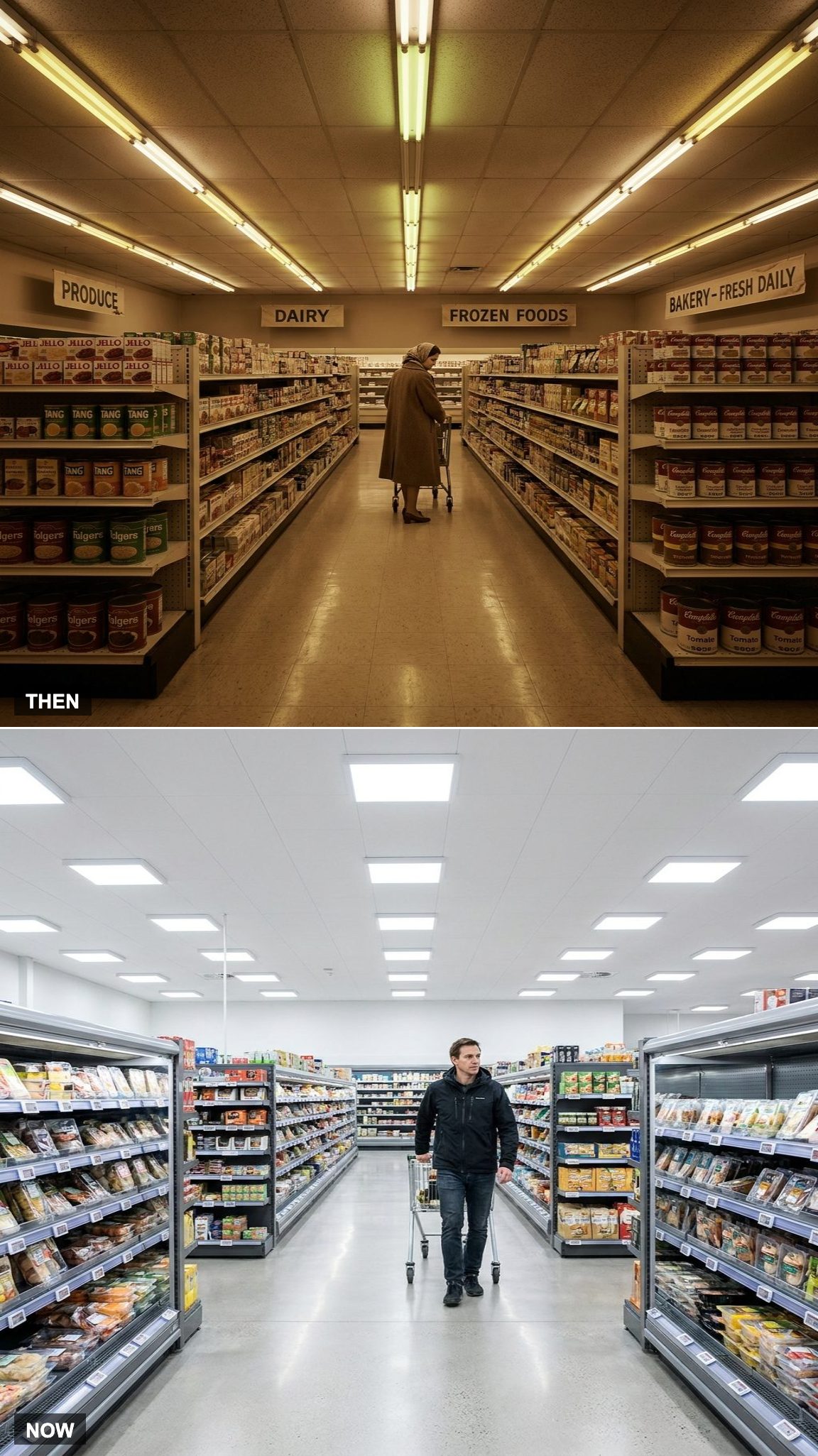
The light in a 1970 grocery store had a color, and it was cool, slightly green, and uneven. Long fluorescent tubes hung from a low ceiling, one or two always flickering or gone dim, and the whole room glowed like the inside of an old refrigerator. It made the meat look a certain way and the produce look tired, and nobody thought twice about it.
Today the lighting may come from even LED panels, warm recessed cans, or daylight admitted through skylights. Many stores have also removed acoustic tiles to expose painted joists and ductwork, turning the ceiling itself into part of the design.
12. What You Walked On
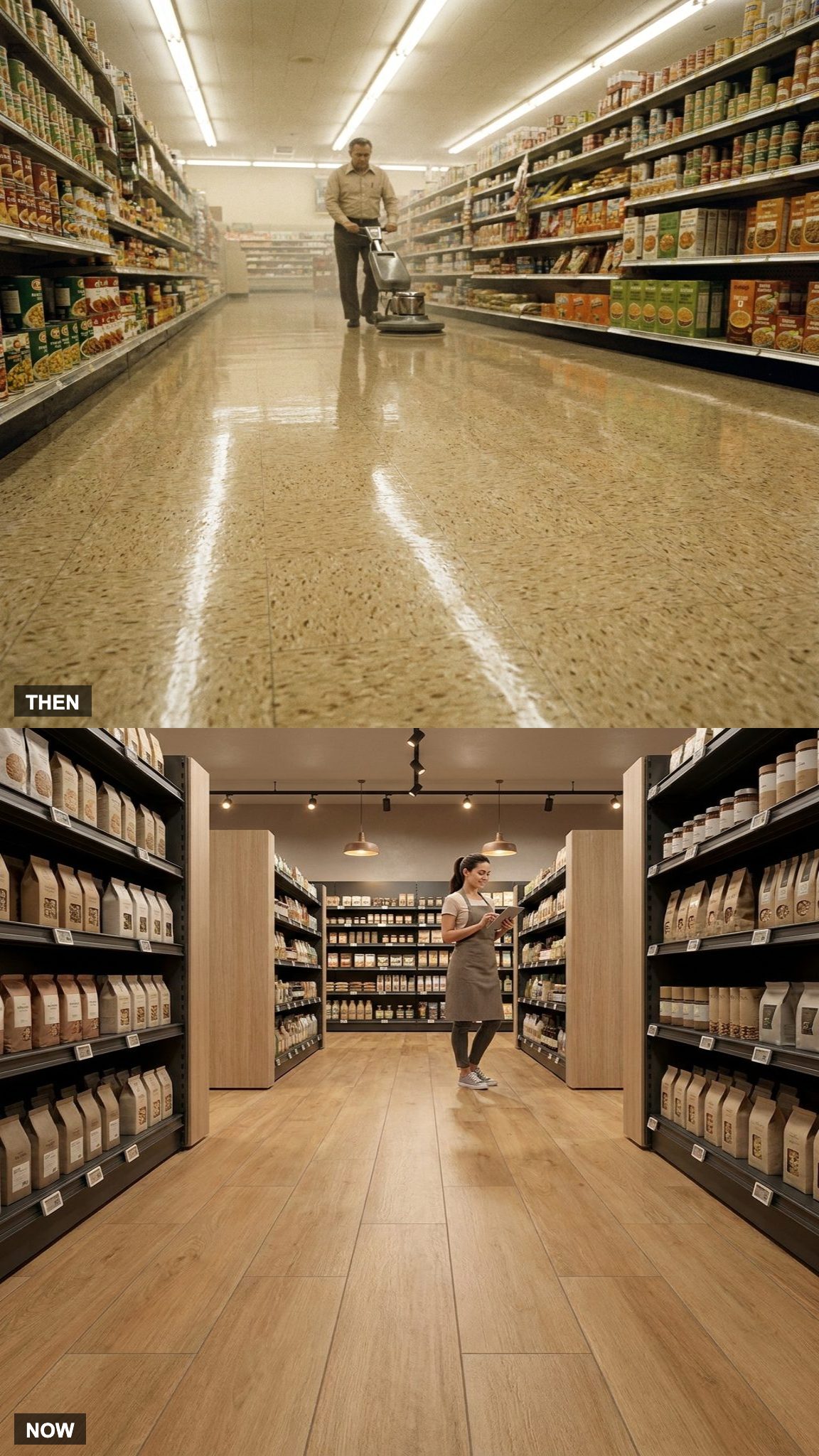
That waxed vinyl tile squeaked under your sneakers and threw the ceiling lights back at you like a shallow pond. Beige with brown flecks, chosen to hide dirt, buffed by some guy with a floor machine at six in the morning. You could smell the wax before you even turned down the aisle.
Today it’s polished concrete or wood-look porcelain, warm and matte, meant to feel like a nice kitchen instead of a hospital corridor. The floor stopped shouting and started setting a mood.
11. The Signs That Pointed the Way
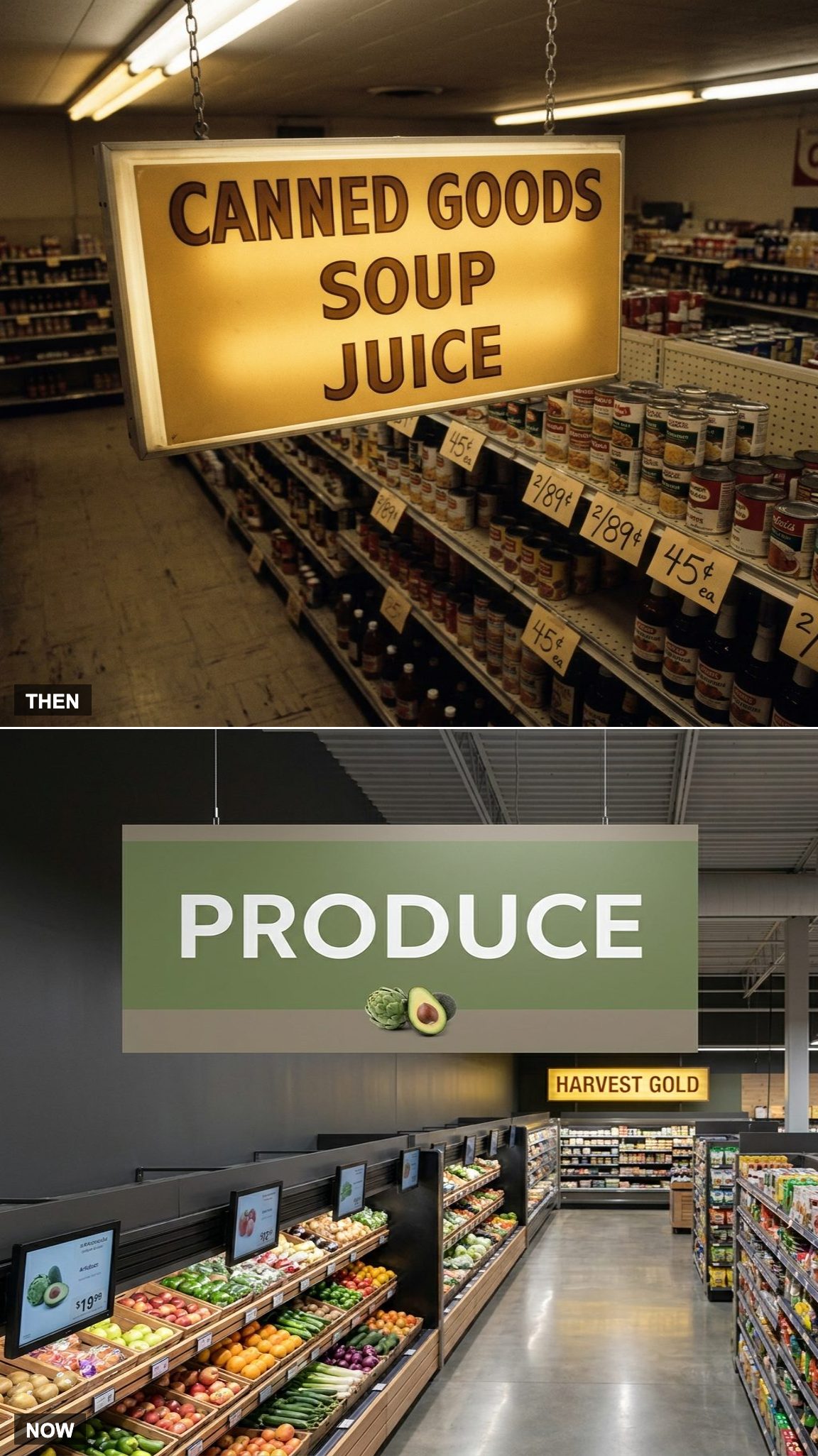
Aisle signs in 1970 were backlit plastic boxes hung on chains, harvest gold with brown block letters spelling CANNED GOODS or SOUP JUICE all crammed together. Half of them buzzed. Some hung crooked and nobody minded.
Now a single word floats on a matte panel in oversized clean type, perhaps with a small photograph of an olive or a loaf. Fewer words, more air, and less need to decode three product categories squeezed onto one sign.
10. The Weekly Special Pile
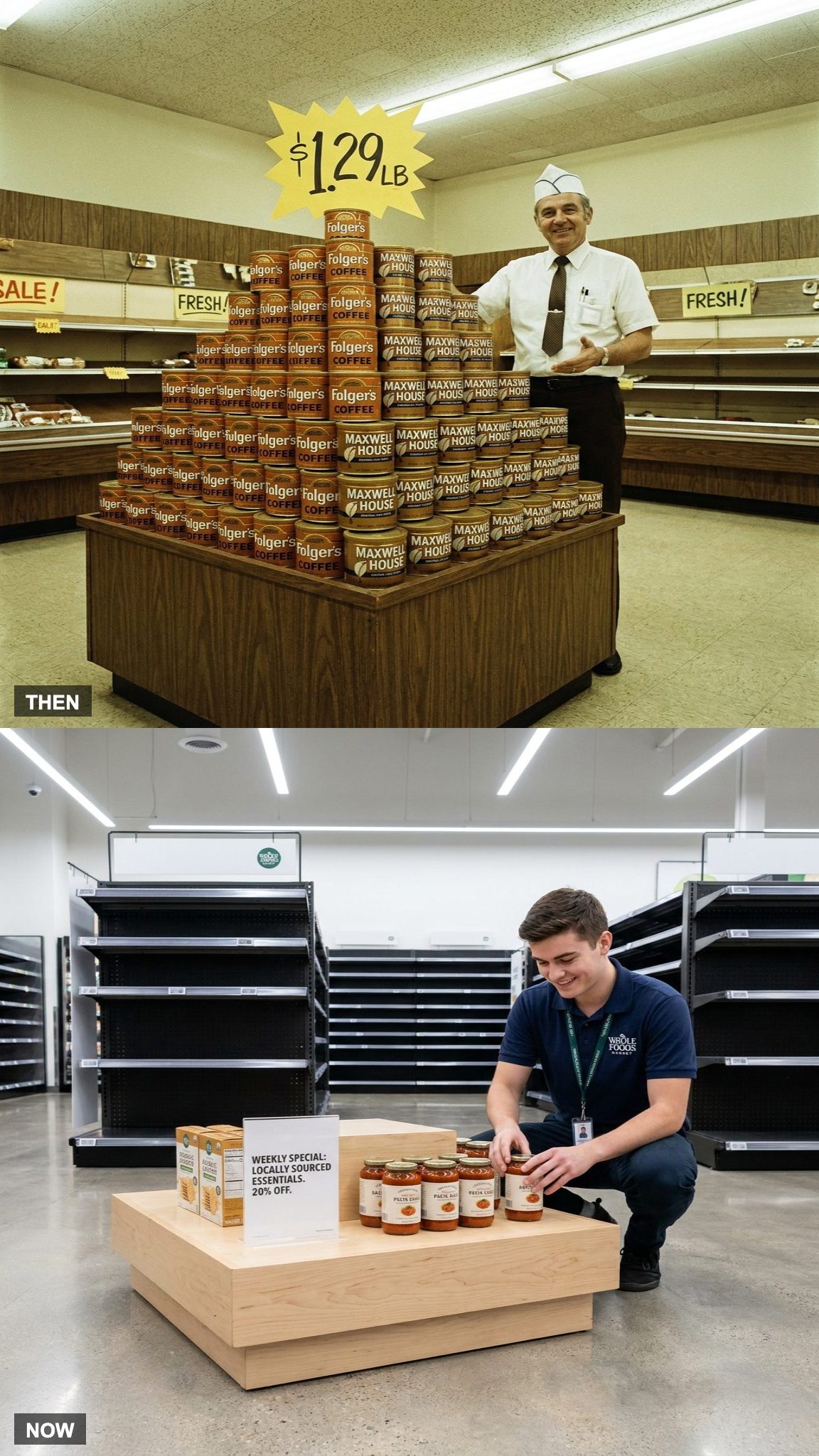
The weekly special was a monument. A chest-high pyramid of coffee cans or creamed corn, built by hand, topped with a poster-board starburst and a price scrawled in fat marker. You half expected the whole thing to come down if you pulled from the wrong row. Kids did. Managers loved the drama of it.
The modern version is restrained to the point of shyness: a low riser, a few facing rows, one printed card in tasteful type. Less product, more breathing room. The pile stopped being a stunt and became a polite suggestion.
9. The End of the Aisle
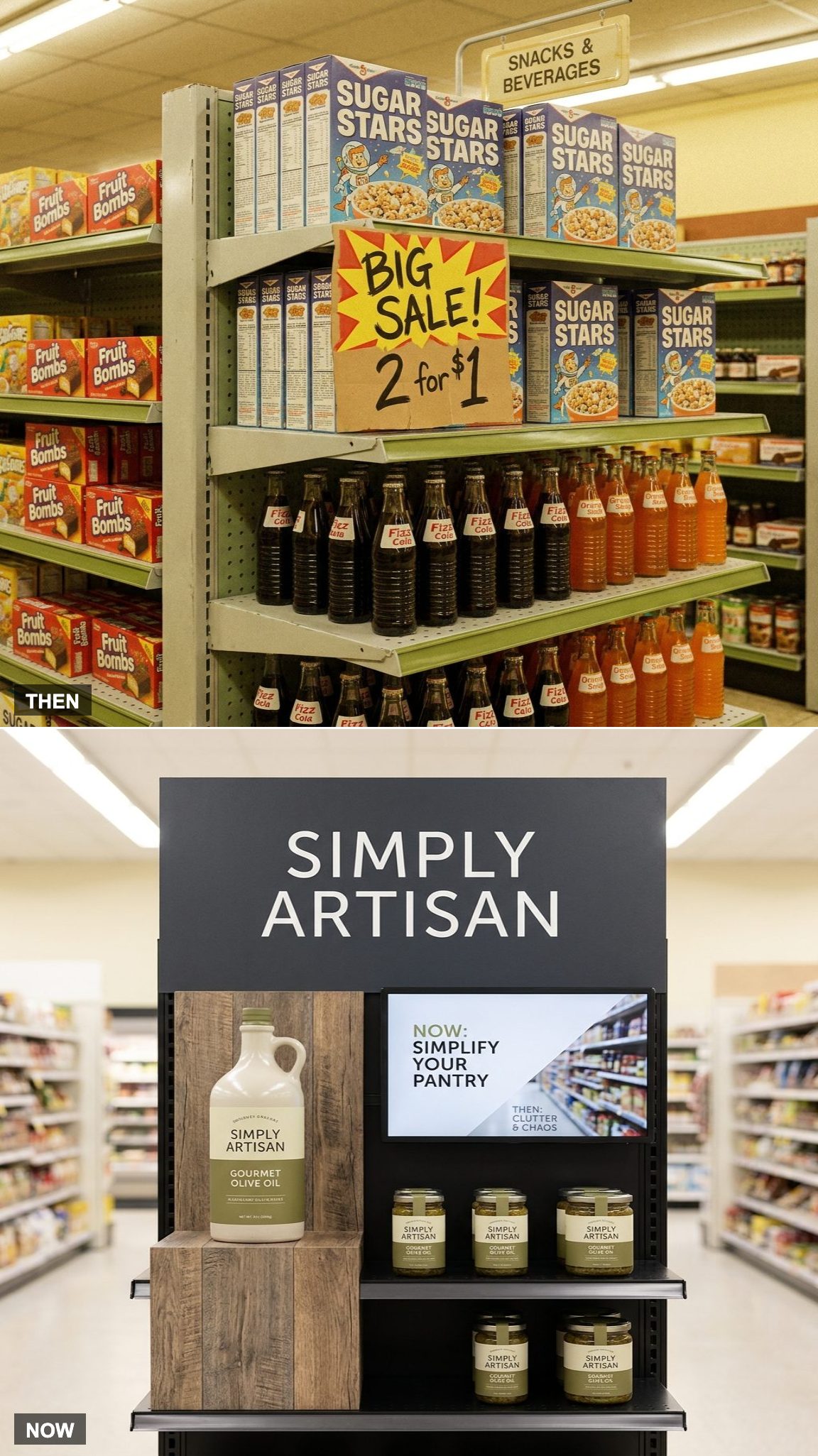
End-caps in 1970 were controlled chaos. Cereal boxes, snack cakes and soda jammed edge to edge, a cardboard sunburst yelling SALE, not one square inch left empty. The logic was simple: cram it, and somebody grabs it on the way past.
Now the end-cap is a stage for one thing—a branded header, a single hero product, coordinated colors, room to see it. Retailers figured out that empty space around a product makes it feel more important, not less.
8. The Service Desk Up Front
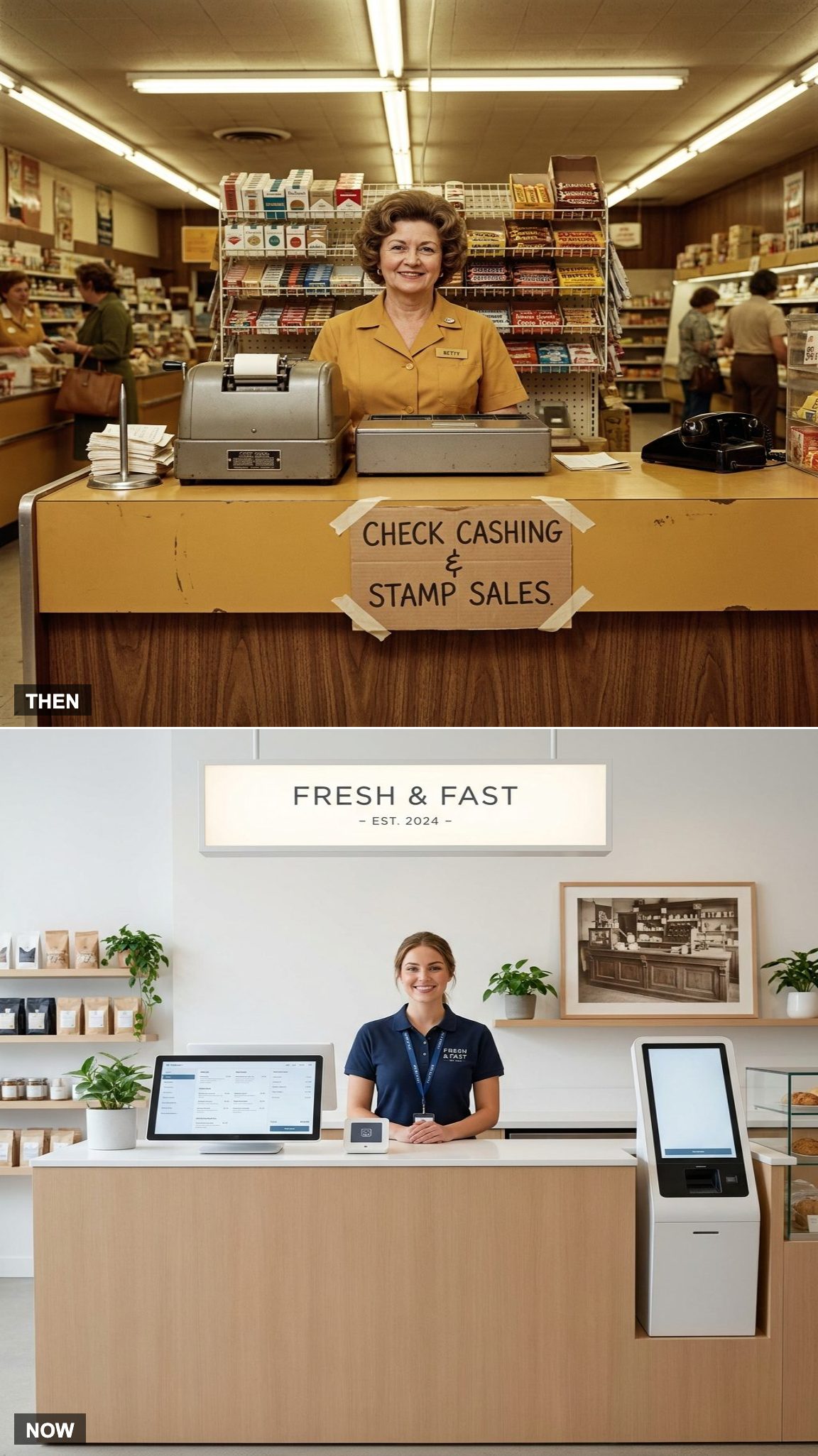
The service desk ran on paper and a person who often knew the regular customers. Harvest-gold laminate counter, an adding machine, a rotary phone, cartons of cigarettes stacked behind, and a hand-taped sign for check cashing and stamps. The woman in the mustard smock could cash your check, sell you a money order, and ask about your mother in the same minute.
Today? A touchscreen, a card reader, a kiosk for online-pickup orders, and a lot less conversation. Faster, cleaner, and quieter in a way you don’t entirely love.
7. The Flower Corner
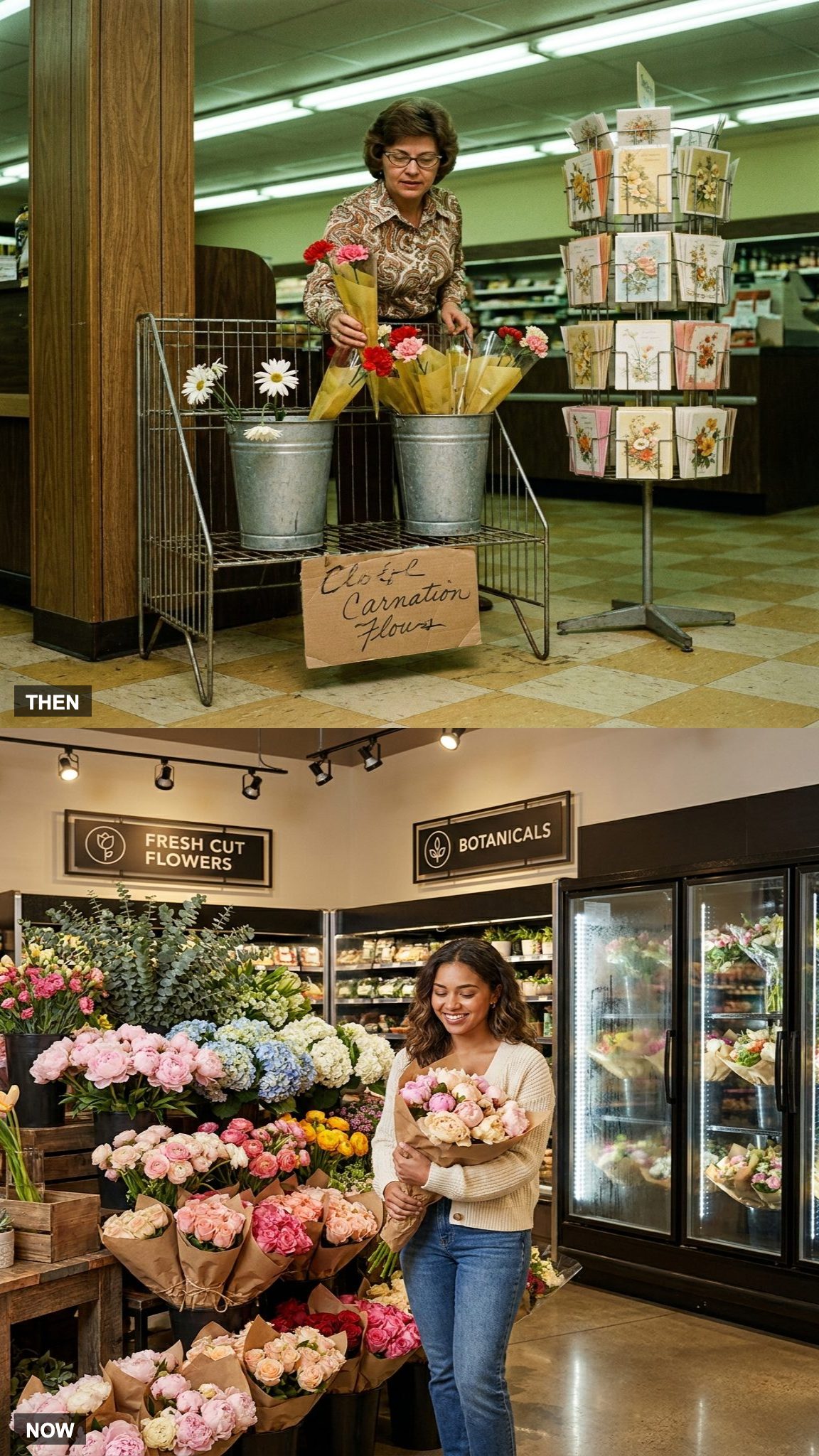
In 1970 the flowers were an afterthought. A metal rack, a couple of galvanized buckets holding cellophane cones of carnations and a few tired daisies, parked next to the greeting card spinner. You grabbed them because you forgot an anniversary, not because you wanted them.
Today’s floral department is a whole event. Tiered displays, eucalyptus and peonies and hydrangeas by the armload, kraft-paper wraps, a refrigerated case keeping everything crisp. The carnation went from apology to centerpiece.
6. The Pharmacy Counter
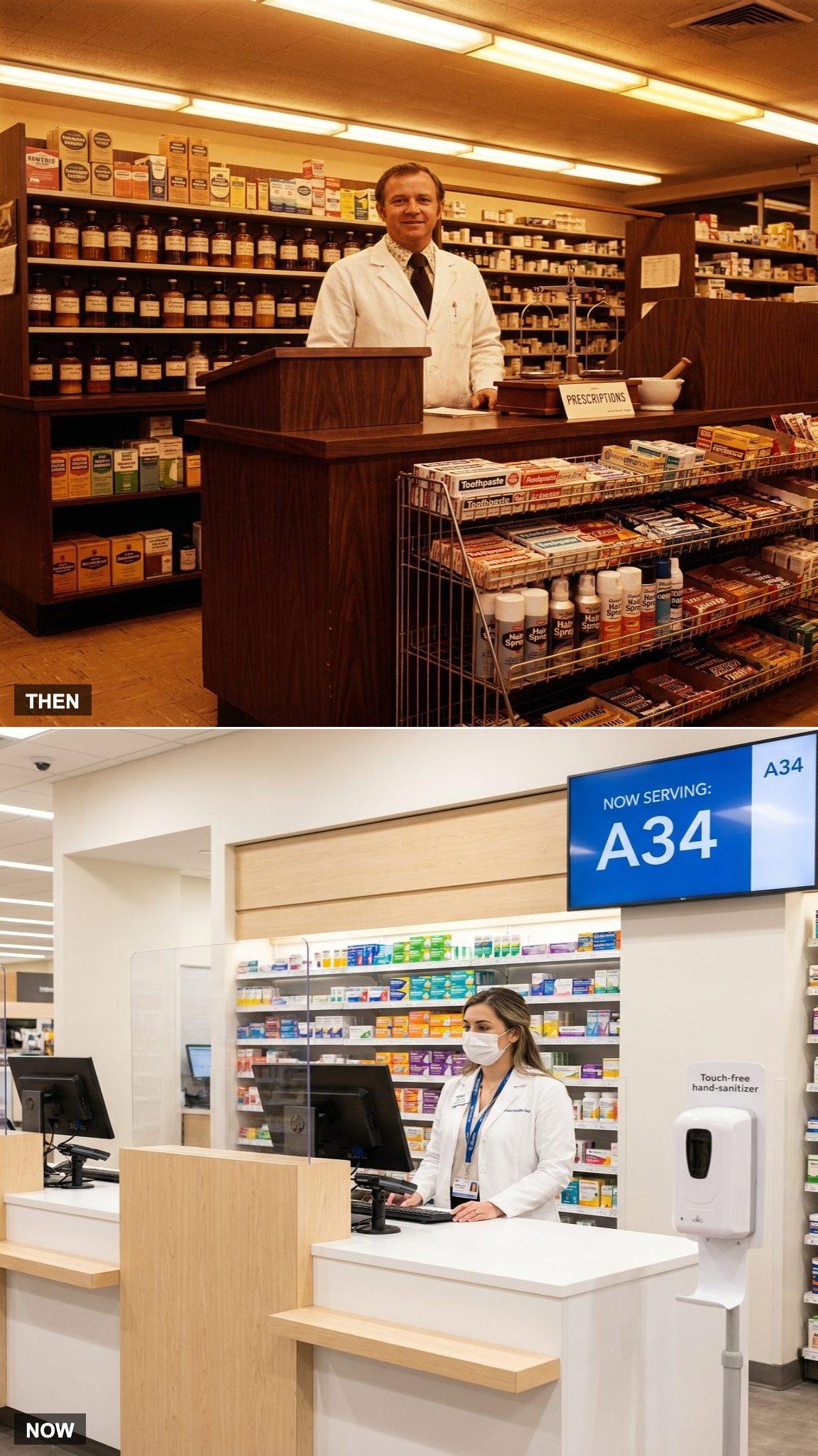
The pharmacy felt like a little apothecary bolted onto the grocery. A tall wooden counter, amber glass bottles lined up behind, a mortar and pestle sitting out like proof of craft, and a pharmacist in a white coat who typed the label and often recognized the family and its prescription history.
Now it’s terminals, a privacy window, a digital queue number and a wall of blister packs organized right down to the letter. Cleaner and faster. Amber containers remain, although plastic has replaced much of the glass and much of the visible preparation has moved behind partitions and automated systems.
5. The Health Food Shelf That Became an Empire
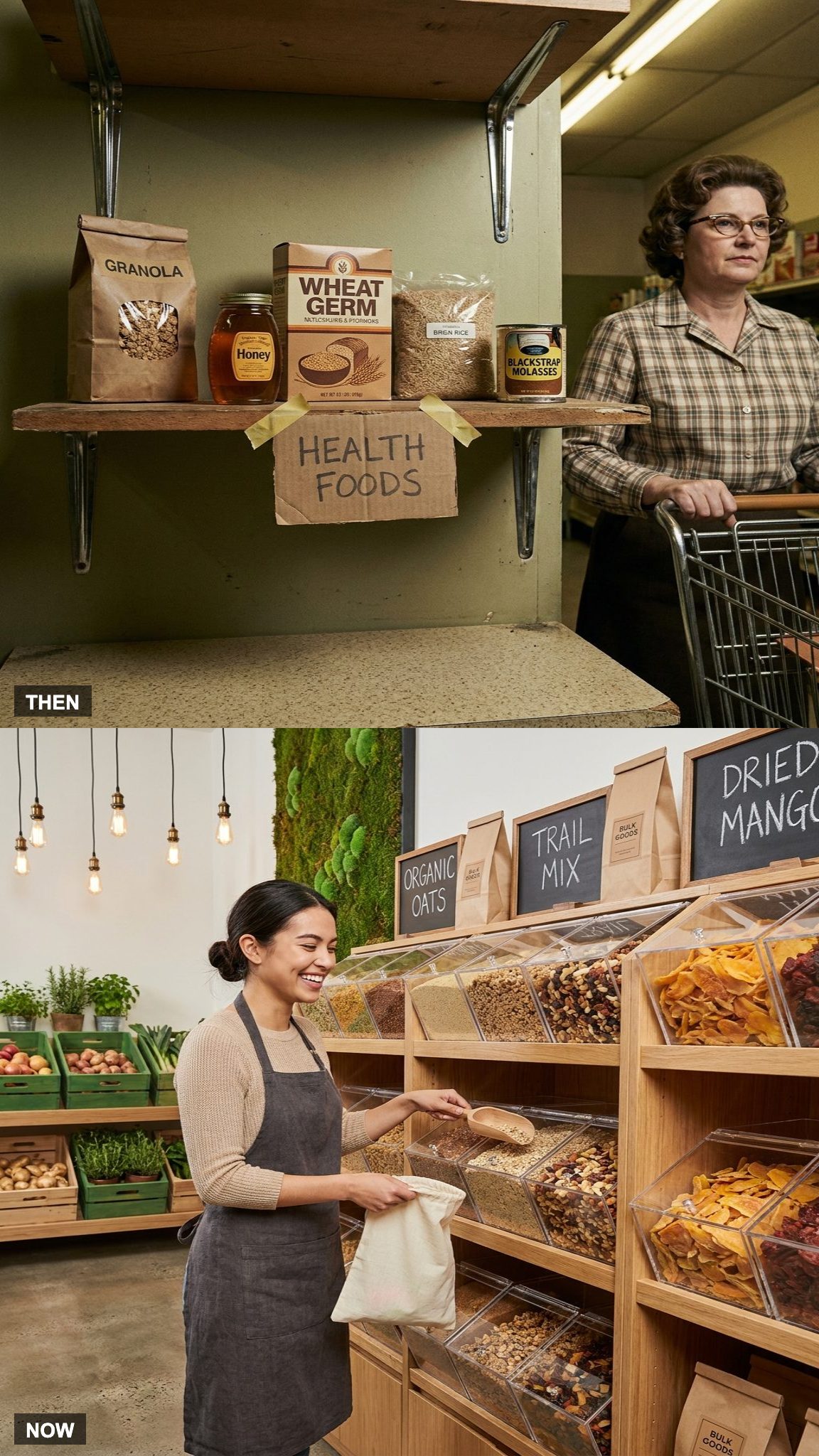
Natural and health foods occupied a small, marginal section in many conventional supermarkets. Wheat germ, a jar of honey, a bag of granola, brown-rice packages in earthy fonts, and a hand-taped HEALTH FOODS sign that somehow made it all sound faintly suspicious. Most shoppers walked right past.
That marginal shelf grew into a major department in many modern stores. Bulk bins with wooden scoops, produce in green crates, kraft packaging and chalkboard signs, an entire department devoted to something that once sat at the margins.
The strange corner shelf of 1970 became one of today’s most valuable departments.
4. Coffee Bars and Seating: From a Bench Out Front to an In-Store Café
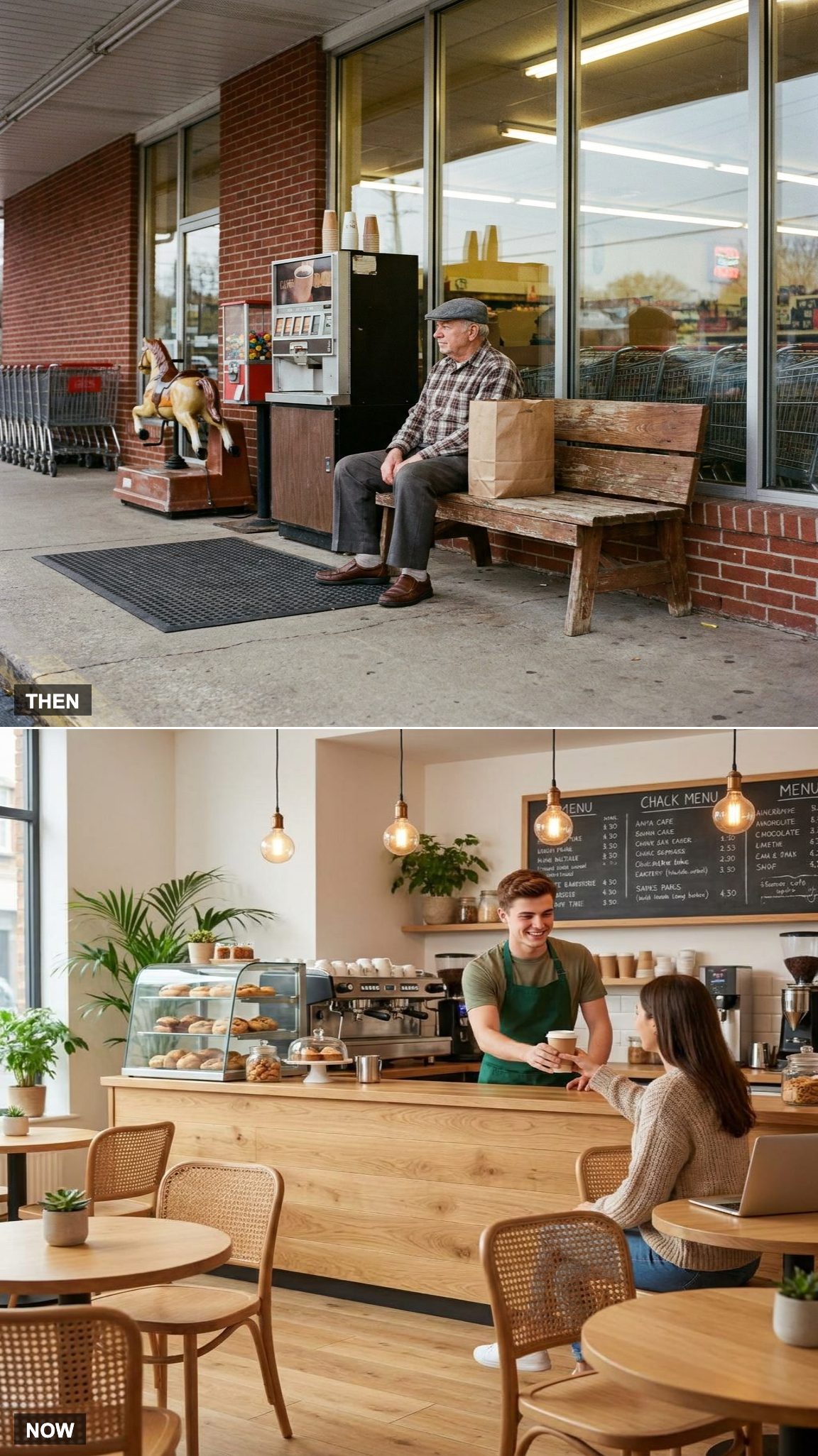
Seating in a 1970 grocery store meant a bench by the door and a machine that spat lukewarm coffee into a wax cup for a dime. You sat because your feet hurt or your ride was late, never because you wanted to linger. Who lingered in a grocery store?
Now there’s a barista pulling espresso next to the produce, oat milk on tap, and people camped out with laptops like it’s an office. The seating encourages customers to remain in the store longer, turning a grocery trip into another kind of visit.
3. Grocery Pickup and Delivery: From the Boy Who Carried Your Bags to Curbside Slots
Would you like to save this?
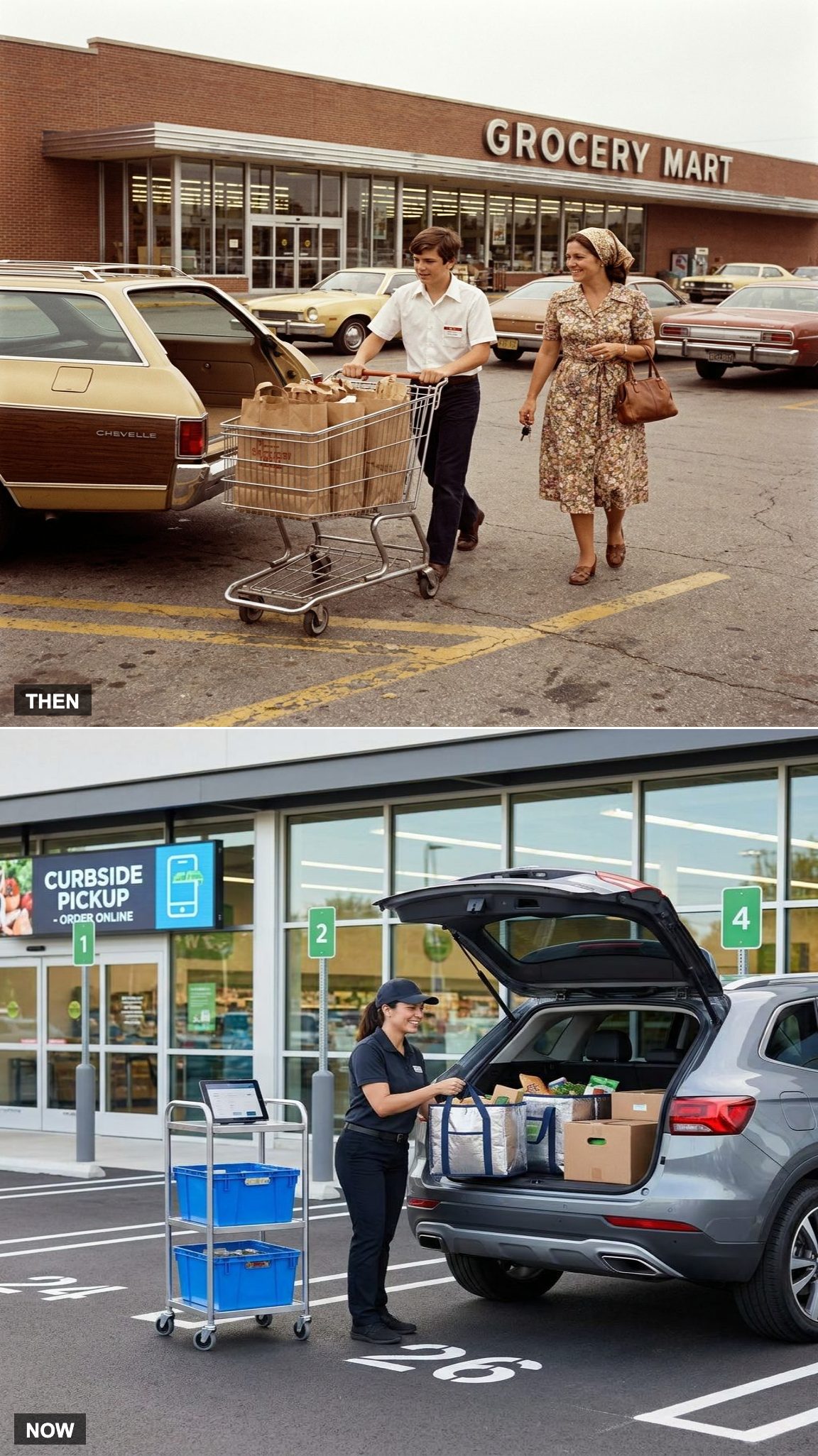
Getting your groceries to the car in 1970 was a person. A kid in a white shirt loaded the paper sacks into the back of the wagon and said thank you ma’am, and you tipped him a quarter if you had one loose.
With curbside pickup, you may never walk inside. You order on your phone, park in a numbered slot, and a worker with a tablet and insulated bags fills your trunk while you keep the engine running. The whole transaction happens in the parking lot. Efficient. A little lonely. The quarter tip is now a line item on the app.
2. Bulk Sections: From Natural-Food Bins to Warehouse Pallets
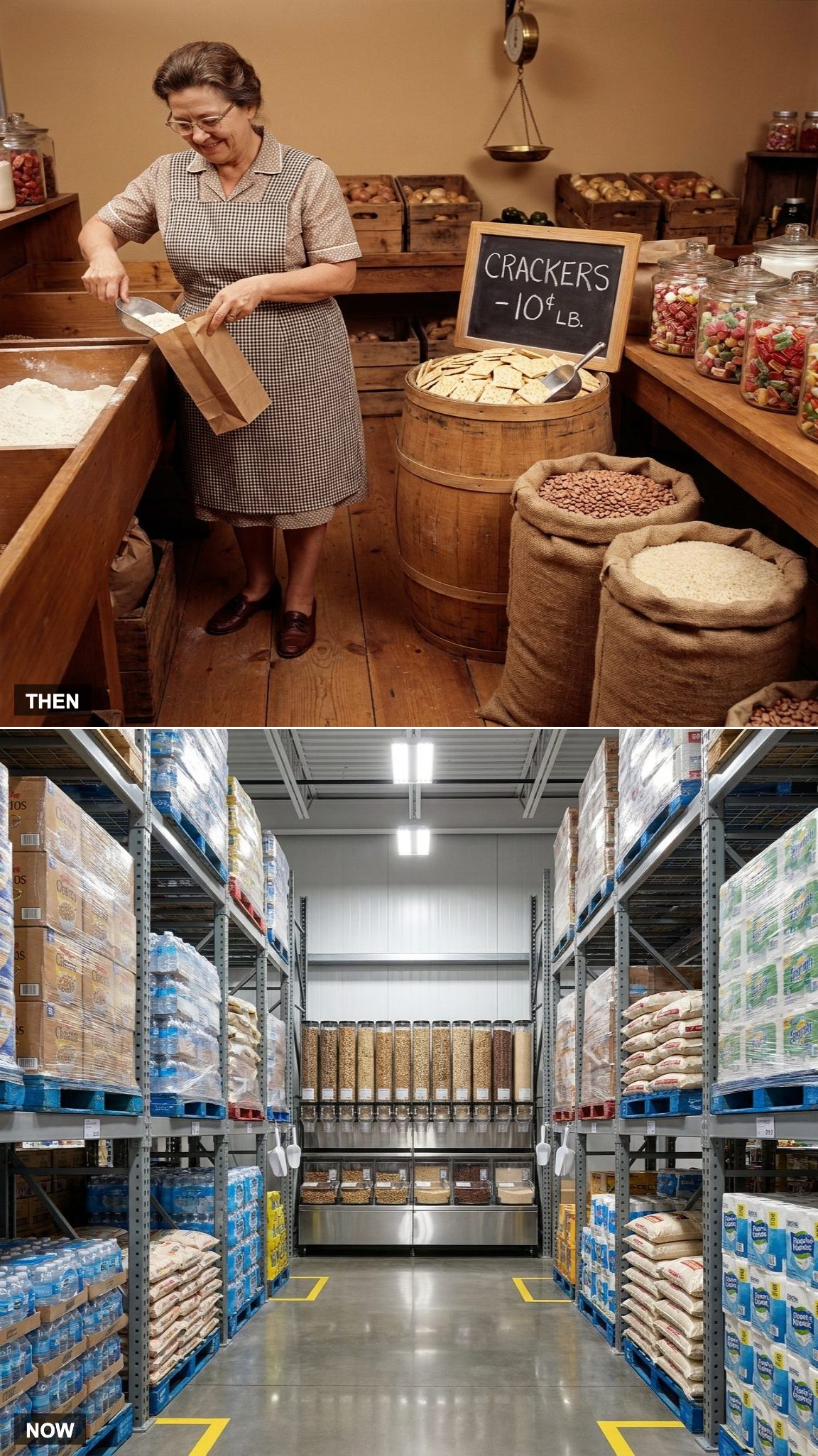
Bulk food was limited in a typical 1970 supermarket, although natural-food stores and cooperatives sometimes sold grains, beans, and nuts from bins. You chose an amount, weighed it, and carried it home in a paper bag.
Now the word can mean either unpackaged food sold by weight or a warehouse club with steel racks, shrink-wrapped pallets, and a cereal box the size of a suitcase. You buy the 48-roll pack of paper towels because the per-unit math tricks your brain into feeling smart. Different kind of scoop entirely.
1. Overall Store Layout: From Manageable Supermarket to Cavernous Supercenter
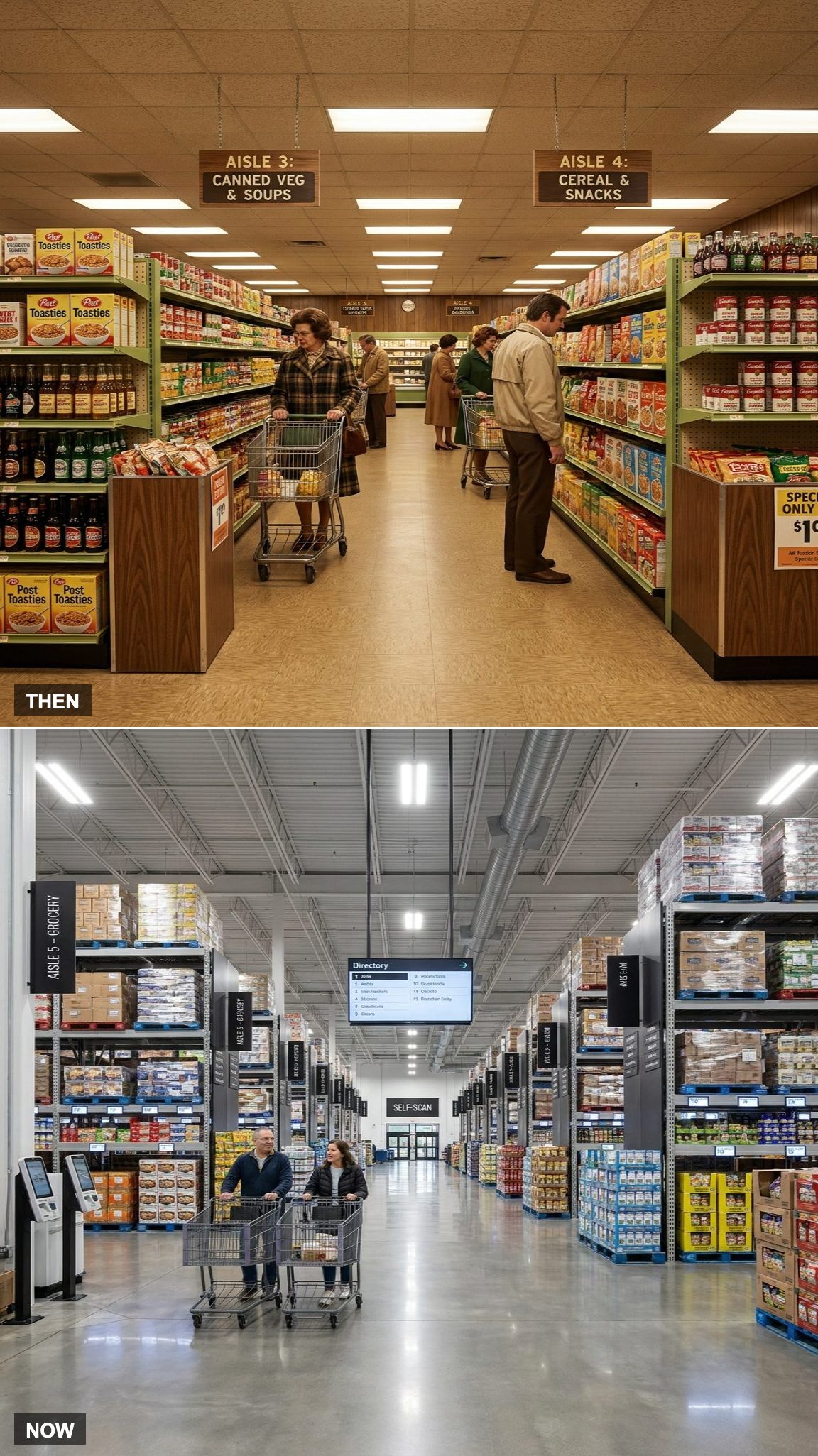
A 1970 supermarket was already large by earlier standards, but its footprint was usually easier to hold in your head. Low ceilings, aisle signs on chains, shelves you could see over, and a layout your mother could walk blindfolded. You knew where the cereal was, and you knew the cashier’s name.
Walk into a supercenter now and it’s a hangar. Ceilings vanish into ductwork, aisles stretch like runways, and there’s a pharmacy, a bank, an optometrist, and a rotisserie somewhere in the fog. You need the app just to find the ketchup.
The old store fit in your memory. The new one needs a map on your phone.